Image Map
Showing posts with label Family. Show all posts

Thursday, April 13, 2017

Pink Peppercorn Lemonade Macarons

My maternal grandfather passed away a year and a half ago.

He was the one person in my family that had never criticized or questioned where I was going in life, besides my paternal grandfather. 

Through every drama-queen fit of histrionics, normal teenage angst--oh hell, even when I shat my pants when I was around four and started bawling, he would figuratively kick my ass and then pick me back up.

When I got diagnosed with severe clinical depression at only twelve years old, he was there for me. When I dropped out of college, he was there for me.

Even though he provided the money for my college education and my withdrawal wasted a great deal of his hard-earned money, he said nothing besides reassuring me he knew I was going to go on to do great things, no matter what, and he'd always be in my corner.

His quiet, unassuming confidence in me is something I find unbearable when I'm depressed. How could I ever live up to his expectations of me? I can't even put the right words to paper (or in this less romantic digital age--fingers to keyboard) to properly describe this man, let alone accomplish anything worthwhile or lasting.

My paternal grandfather passed away a couple of months ago.

Sunday, December 18, 2016

Mulled Wine Stuffing with Sausage and Chestnuts

Here's another special holiday family recipe from my mother that I had to make sure I learned how to make. This stuffing is possibly my favorite culinary aspect of the holiday season!

I love how the wine gives this stuffing acidity and a little bit of bitterness to cut through the richness of butter, sausage and bread. Most stuffings can be be a little stodgy and bland, and the use of the mulled wine brightens it up.

I've written about this stuffing on my slow cooker mulled wine recipe, as that is the ingredient that really makes this stuffing.You can add in dried fruit or nuts, or remove the meat entirely. It will still be acceptable to me. However, if you omit the mulled wine, it just won't taste right in my book. This is the only stuffing for me!

Now, the big trend for food photography for stuffing is giant pieces of bread that toast up nicely in the oven and make for a glorious picture, however I don't think that tastes as nice because everything doesn't have a chance to incorporate. If you prefer a drier stuffing, reduce the liquid to 1 cup each of broth and mulled wine. I like mine nice and mushy and don't really care if that's not as attractive to photograph. 

Monday, December 5, 2016

Curried Persimmon Ham

My mom is a mad scientist when it comes to cooking. She is constantly opening up her cupboards and fridge, giving them all a good look, pulling out a motley crew of items, and slapping together something that may never be replicated. Her Turkey and Hominy Soup that I've written about is a great example, because it is really never the same batch twice. She throws in so many different things and in different quantities, it's hard to keep up, let alone write the recipe down.

She also has a gift for making mass quantities of food. If the recipe serves more than 1-2, it's a fair bet it was originally my mother's recipe. I don't have much occasion to cook for a small army, but around the holidays is the best time to cook for a crowd because you never know what sort of get-together you'll host or be invited to! My mother brings this ham to potlucks, and even gives it away as holiday gifts, that's how popular it is!

I don't think even she could come up for a thought process for this recipe, besides noting she had a lot of persimmons, and a stray block of Japanese curry roux rattling around her pantry. She moves on instinct, a trait that I did not inherit. I spend a lot of my time thinking, not just about food.

Wednesday, November 23, 2016

Persimmon Pudding

It's persimmon season! Every year, my great uncle's trees bless us with more fuyu persimmons than we know what to do with. I've shared lots of recipes over the years and suggestions for what do with the fruits besides eating them plain, and it's become a Thanksgiving tradition to whip up something with persimmons.

I asked my mom what she wanted to see this year, and her answer was persimmon pudding!


There are two basic types of persimmon, or kaki (柿): the squat Fuyu that can be eaten crisp like an apple or the heart-shaped Hachiya type that is ripened until jelly-like inside. The Hachiya cannot be eaten hard because it is very astringent unless fully ripe.

Now persimmon pudding is traditionally made with the Hachiya type (or the wild American native persimmon which is similar in texture to the Hachiya), however it can be made with fuyu. You just need to let them over-ripen to a jiggly state. Generally speaking, there's always some of our fuyu that manage to overripe before we get through our bunker crop!

No matter what variety you have on hand, make sure they are jiggly-about-to-burst ripe. We want to highlight that custardy texture of the pulp in this recipe.

Tuesday, November 22, 2016

Julia's Korroke

All I wanted for my birthday was to learn how to make Julia's amazing korokke. Julia is one of my mother's very best friends and someone I consider to be part of my family. They've known each other since before I was born, and I grew up going over to their house, going on road trips together, and spending holidays with them.

I learned to ride horses with Julia's instruction, while her husband introduced my brother and I to the awesome world of computer games. I was too young to notice it at the time, but they were very influential in my life, encouraging me in my academics but also my hobbies as well. I'm thankful every Thanksgiving I've had so many amazing role models in my life. I know that sounds super cheesy, but you haven't met them! Our families go camping together, horse trail riding together, and even thrift shopping with one another! I especially like playing board games at their house, and wish my work hours didn't prevent me from seeing them as often as I'd like.

Julia's son got me set on this idea when he mentioned that his favorite part of Thanksgiving was his mom's croquettes, which is served with the traditional okonomi sauce (sosu), but also ranch dip. It just wasn't Thanksgiving without it, in his opinion.

Ranch dip? On korokke? I had to see this. And then Julia brought some over to my parent's house, and I was hooked. I would have never in a million years thought that ranch would work with croquettes, but it is delicious. I personally liked to alternate between the okonomi sauce and the ranch dip, so each bite sings.

Korokke, or Japanese croquettes, are very similar to the French croquettes, but are usually made with a higher ratio of potatoes to meat and served with the same family of tangy sauces that tonkatsu and a lot of fried foods is served with.

Sunday, October 9, 2016

Adventures in Japan: Hiroshima and Miyajima!

The places in Hiroshima we visited weren't exactly fun, but they were important.

They really made me wonder what would have happened if Japan hadn't tried to expand their power into the mainland and fought in WWII. Would I be fluent in Japanese? Would I have known my relatives in Japan better? Would I even exist? All the fear and hatred of the Japanese here in America: would my grandmother have known a life without that constantly over her shoulder?

And I know that going to such a museum and thinking about how everything affected you and your loved ones is probably the height of arrogance, but that's how I felt. I also felt numb at how pointless it all was, the wars, the bombs--every time someone picks up a gun in the name of their country. A city devastated, thousands killed, nothing gained, and ultimately everyone loses. And we as a species do it over and over again. I think that what depressed me the most is that I couldn't think of a good way out of this spiral of hatred. It's been over 70 years and we are still killing each other.

A beautiful but sad sight: millions of paper cranes
We visited the Hiroshima Peace Memorial, also known as the A-bomb Dome (shown above), the only building left standing in the atomic bomb's hypocenter, and visited the Hiroshima Peace Memorial Museum. Inside the museum, we saw many artifacts from the blast as well as details of their survival following radiation exposure. What stuck me most was the Peace Watch, which resets itself every time a nuclear test is performed around the world. It struck me how fragile peace truly was, with so many countries not only capable of leveling an entire city with a single missile, but actively testing the technology.

After a sobering day of memorials and millions of paper cranes, we went to Miyajima island and I have to say it was probably the prettiest part of the entire trip. The cherry blossoms were at their peak and it was mind boggling. The petals really do cascade like snow falling when the wind blows, and I danced around in them without shame.

Monday, September 12, 2016

Adventures in Japan: Beppu and Yufuin!

Beppu and Yufuin are both resort towns in the Oita prefecture in Kyushu. We stopped at both along our way back from Yawatahama back to Fukuoka.

Beppu and Yufuin are both famous for their onsens, but the Eight Hells of Beppu (別府の地獄), where you can see plumes of steam rising was quite the impressive sight! Even when driving around we could see plumes of steam rising around the city. It was very eerie as it looked like the whole place was about to go up in a volcano.

Check out the steam plumes!
After leaving Yawatahama (I fell asleep on the ferry back, it was a very long day), we arrived in Beppu to spend the night at the Umine hotel in Beppu. Our relatives wanted us to try the onsen hot springs that Beppu is famous for, but worried that we would balk about getting naked in a public onsen. So instead, this hotel had a private onsen bath with an ocean view in our hotel room! The hot spring water is piped into an outdoor patio for private enjoyment without having to even leave your room.

Sunday, September 11, 2016

Tenjosajiki Cafe (天井桟敷)

After leaving Beppu, we drove up and down mountains to reach Yufuin. We stopped by Yufuin on our way back to Yawatahama for a quick visit so our relatives could show us more of Kyushu.

While in Yufuin, we stopped by Kamenoi Bessou (亀の井別荘) a ryokan (inn) that included hot springs, a wonderful souvenir shop, and a restaurant space upstairs that was a cafe during the day and a bar after 7pm, called Tenjosajiki Cafe and transforming into Yamaneko (山猫) at night.

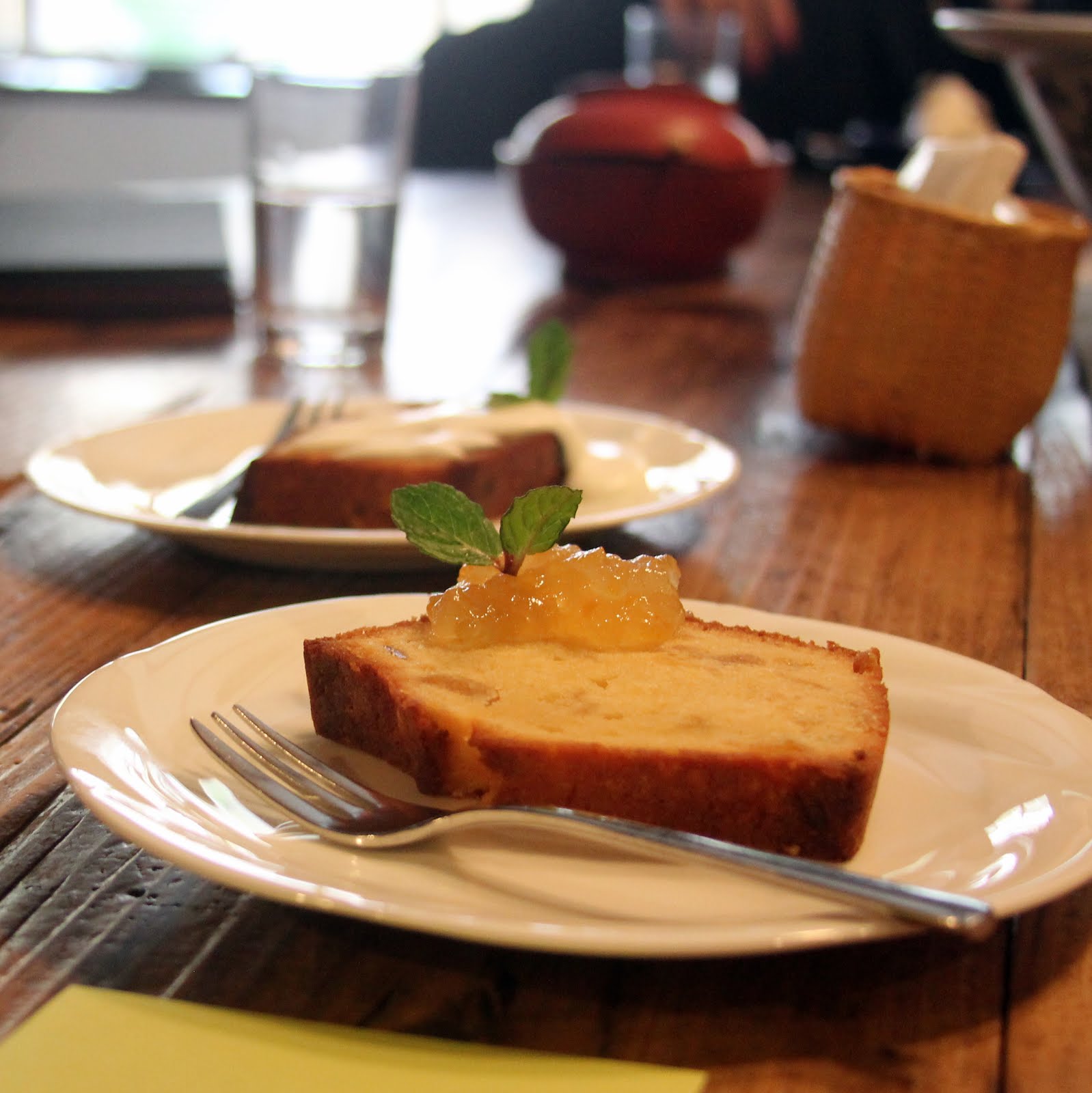
The ume pound cake
We picked up some citrus jam from the ryokan shop and ate it with toast all throughout our trip. It was less like a kitschy American souvenir shop and more like a luxury specialty shop that focused exclusively on regional and seasonal items. I loved browsing through there!

And stepping outside to take in the greenery surrounding this ryokan was magical: the mists swirled around lush greenery, cherry blossoms, and leafy trees. For a Southern California resident used to nothing but drought, it was truly like being transported to a magical forest.

Thursday, August 25, 2016

Adventures in Japan: Yawatahama!

Do me a favor and google some travel blogs for visits to Yawatahama. Okay, how about Shikoku in general? Not finding a plethora of pictures?

Not a lot of westerners make it to Shikoku island at all, let alone Yawatahama, but that is where we went next on our adventure through Japan. Our wonderful relatives drove us all the way from Fukuoka to Beppu, where we caught a ferry to Yawatahama to see our ancestral home and our family's grave site.

Shikoku is the smallest and least populous of the four main islands of Japan, and the JR railway express only has one rail line on the entire island that runs along the perimeter, to give you some scope of how rural it is compared to the massive Tokyo metropolis. Shikoku is famous for its Shikoku Henro, a Buddhist pilgrimage that goes along 88 shrines around the four provinces of Shikoku.

Of course, there's no pilgrimage stop in Yawatahama. Yawatahama is a port city, with the largest fish market in Shikoku with a natural harbor. The main agricultural export is the mikan, or the satsuma mandarin. This reminded me a lot of my home here in Orange County, California as I grew up playing in an orange orchard.

Wednesday, August 24, 2016

Yawatahama Champon (八幡浜 ちゃんぽん)

It was really hard to decide what to make for Yawatahama. I wanted to bring you something not just uniquely from Shikoku in origin, but Yawatahama itself. However, I was a bit stumped. A lot of what makes Shikoku cuisine unique is the island itself. For instance, the most famous local food of Shikoku is sanuki udon because the island has the best wheat production in Japan. However, that dish hails from Kagawa prefecture, not Ehime prefecture where Yawatahama is located.

Citrus is a huge part of Ehime's agriculture, however I don't have access to the more unique citrus that Japan has. I could do a citrus recipe, even though it's summer and citrus is at its peak in winter, and call it good. But there's not a lot of recipes for citrus that are unique to Ehime because the citrus is normally just eaten simply and the fruit is savored in its original form, and I've already blogged about that. I'd basically be slapping together a marmalade and making a flimsy connection to Yawatahama, something I didn't want to do. I could do a recipe of a nearby city, like Imabari or Uwajima, instead of Yawatahama. I found some awesome regional foods when I researched, however they still weren't strictly from Yawatahama.

I guess I stressed over this so much because I felt so connected to Yawatahama when I visited. My family is buried there. My family lived and died, and continues to live, there. Our creaky old ancestral house stands firmly on its soil. A tiny portion of my soul, my very essence, I think was left on that hilltop surrounded by graves and citrus and the smell of the ocean. A bigger portion was left in that house where I shared tea and smiles with family. It's only natural I wanted to share some of Yawatahama's soul with you.

I'm not normally this cheesy, but truly it was a special experience.

So really, the choice was made for me. If I was going to share a bit of Yawatahama's soul, I was going to have to get serious about creating a dish I've never actually eaten: Yawatahama-style Champon.

Sunday, August 21, 2016

Amalfi (アマルフィ)

Before paying our respects at our family grave site and visiting the local temple in Yawatahama, my relatives in Japan took my brother, mother, and I to an Italian restaurant in the heart of Yawatahama called Amalfi. I wanted to share this experience with you as our meal showcased not only the Japanese's twist on Italian food, but also some of the local ingredients of Shikoku. Their attention to detail and ability to express a lot of flavor in small portion sizes were two things I was very impressed with.

Despite it being the lunch hour, our meal was a multi-course extravaganza. I think a lot of restaurants back in the states could learn a thing or two about portion control from places in Japan like Amalfi. This was a five course meal that managed to stay light!

We started out with an amuse-bouche of a warm potato cream soup with a thin savory crisp skewered on top with a side of a house parmesan cream cheese. The potato soup was pleasantly creamy and without any sort of graininess that sometimes happens with potato soup. I was impressed with how they managed to serve it piping hot as I've had amuse-bouches arrive lukewarm by the time they are done plating, and all of ours arrived at once. There was not a large staff by any means, so that meant they worked like lightning!

Tuesday, January 20, 2015

Salted Nut Bars

Best. Cookie. Ever.

No seriously, I'm not the biggest fan of sweets, but this bar cookie rocks. It's an old family recipe that was obviously way ahead of its time because now treats like salted caramel and sea salt desserts are all the rage.

When we used to go up to a cabin in Big Bear Lake, CA to snowboard, my mother would bring these cookies to serve for dessert after her infamous turkey soup. These freeze amazingly, and you can just zap them for a couple seconds to thaw them, or even just wait for your coffee to cool down a bit and they will be edible by then. I just gnaw on them frozen.

Shown here with my Peppermint Sugar Cookies
I love bar cookies because I really hate using a rolling pin. If you look, I haven't included a single recipe that uses one in all my years of blogging. I just don't have the counter space here in my little shit hole of an apartment, and it's a bother. Plus bar cookies are less time consuming to make large batches without having to form cookies. And you never have to worry that you overcrowded the cookies and your cookies will turn out funny shaped as they spread.

Bar cookies are for smart but lazy people, basically.

Tuesday, January 13, 2015

Slow Cooker Mulled Wine

Some of these recipes on this blog are really for my own use. I needed to record them in some lasting way so that way I would be able to recreate them. My mother's Turkey and Hominy Soup, for instance, is a behemoth of a recipe that really stands out like a sore thumb compared to my usual repertoire.

I like simple and fast recipes that usually feed one or two people. Her recipe uses a twenty pound roast turkey and six pounds of hominy to start.

Her recipe takes two days to make normally (one to roast the turkey, another to simmer the bones all day to make the broth), while most of my recipes take less than 30 and some can barely be called "recipes" but more "mildly fun food ideas" in actuality.

So why do I feel the need to record these recipes that really aren't my style? Because someday my mother won't be able to make them. Some day it will be just me in charge of holiday celebrations, and I will be lost as how to capture the nostalgia.

Wednesday, May 14, 2014

Kumquat Tofu Cheesecake

I'm sad winter is over and spring is soon to follow. I love winter because it means our citrus trees start producing, and from winter to the start of spring we get our crop of kumquats, oranges, and tangelos. This year, some unseasonable winds knocked down what remained of our kumquat crop, so I'm glad I got to make this cake for my mother's birthday before that happened!

Don't let the name scare you, this tofu cheesecake isn't a health food. However, it retains that creaminess that you love about cheesecake, while boasting a lot more protein than a traditional cheesecake. I bet you if you chose to stay mum about the fact it was packed with protein, your guests wouldn't even know it had tofu in it. It's also a bake-free cheesecake, which is great since we are having a serious heat wave here in Southern California.

If you don't have access to kumquats, you could serve this with no topping at all, or any fresh fruit that you choose. I think blueberries, strawberries, or raspberries would be a great topping choice! Of course, if you have any jars of kinkan no kanroni in your cupboard, you're good to go.

This recipe is adapted from recipes who use the metric system and different size cups, so while I converted the recipe, I also included some weights where applicable because it's more accurate.

Tuesday, January 21, 2014

Reito Mikan (冷凍みかん)

Exciting news! I am visiting Japan this spring! I can't wait to share the experience on my blog! This is my first time visiting, so I am absolutely thrilled to finally be going! It's going to be a bit of a budget trip, so expect a lot of pictures of 7-11 bento boxes.

One of the places I will be visiting is my family's ancestral home on Shikoku (四国). Shikoku is the smallest of the four major islands of Japan, and is considered the most rural. Most tourists never set foot there, I guess you could say it's kinda like visiting Wyoming instead of New York here in the states.

Within Shikoku, I will be heading specifically to Ehime Prefecture's Yawatahama city. Ehime Prefecture (愛媛県) is the largest producer of citrus in Japan and Yawatahama (八幡浜市) is especially known for its citrus as well as its harbor.

Shikoku island in brown*
I find it slightly hilarious that my Japanese side of the family lives there, since I hail from Orange County, CA and grew up surrounded by a citrus grove.

One of their biggest crops is mikan (蜜柑 or みかん) also known as the satsuma mandarin. These diminutive fruits resemble clementines (marketed here as "Cuties") in their small size, but their bumpy loose skin with large pores make the mikan look more rustic. I love these seedless wonders, especially their lack of pith and easy-to-peel skin.

So until I finally set foot in the Land of the Rising Sun, I'll be trying to share some Shikoku specialties! First up is a fun quick snack, reito/reitou mikan, which is actually popular all over Japan. There's even a crazy song about reito mikan.

Tuesday, December 10, 2013

Chai Persimmon Sorbert

My great uncle grows the crisp variety of persimmons ("kaki" 柿), called fuyu. Every year, I am entrusted with a giant Trader Joe's bag full of the beautiful orange fruit. I should have weighed the bag to find out exactly how many pounds, but trust me when I say it's way too many for one Miss Mochi to eat.

I stuffed them into bundt cakes for Thanksgiving. I chopped them over Greek yogurt and granola, sprinkled with cinnamon for breakfast. I served them as an appetizer with brie and crackers. I made bowls and bowls of fruit salad.

They were still ripening too fast for me to consume or cook them all fresh. I had some so ripe they were jiggly custard bombs ready to explode. I needed to do something, stat.
Betty has a new attachment!

And then I found this recipe, and swooned immediately. I knew exactly what I would do to salvage all the overripe persimmons crowding my counters. I knew this was what I was looking for, and I couldn't wait to play up the natural spiciness of the persimmon with strong chai tea rather than plain black tea. I also couldn't resist using a gift card to get myself an ice cream maker for my tangerine-colored mixer, "Betty."

This recipe can be made with either the hachiya, which is astringent until it is ripened to jelly-level, or the fuyu, which normally you would eat when it is as firm as a pear or apple, but the fuyu is perfect for this if you let them ripen past that.

Saturday, November 30, 2013

Turkey and Hominy Soup

This recipe is legend among our family and family friends. Every fall and winter, my mother makes several giant batches to dole out with crusty bread on cold nights. My mother refers to it simply as "Turkey Soup," but in reality it is so stuffed with ingredients it's hardly a soup anymore. The way my mother cooks is to generally clear out her fridge, chucking things in until she thinks it "smells right" so this isn't exactly a recipe that was easy to write down, but it is certainly one that it is tailor-made for alterations.


Don't like hominy? Well I think you're nuts, but feel free to replace them with some kidney beans, or whatever strikes your fancy (or you have in your cupboard).

I happen to love hominy in a big way, it's always been my favorite part of this soup. For those of you not familiar with hominy, it is corn that has been treated with lye making it puffy and delicious in a process called nixtamalization. It is the precursor to masa, the ground corn dough that makes up tortillas, tamales, and papusas. The name "hominy" comes from the Powhatan tribe of American Indians, and many traditional American Indian diets included hominy.

Look how big that can is! IPhone for size comparison.
This recipe is very typical of my mother's cooking, almost spartan in its preparation. No added salt, no added fats, no giant mess of spices. While the stock is made in a French manner, with the classic mirepoux of celery, onion, and carrots, one could see a lot of Japanese American influences even in her Western-style cooking. The mottainai "waste-nothing" attitude behind using the leftover turkey bones to make her own stock and clearing out the cupboards and fridge for a soup that is always changing depending not only on the season but the very day she cooks it, for example.

Thursday, November 7, 2013

Fall Fruit Salad

I love fall. I love finally getting to put on a sweater, drink hot tea, and slurp ramen without the aid of air conditioning. Hailing from Southern California, our seasons aren't as distinct as other places. Especially these days, the seasonal drinks from Starbucks seem to guide people through the year more than anything; coconut frappuccino in the summer, pumpkin spice latte for fall, and peppermint mocha in the winter.

I never grew up with explosions of sunset-colored leaves falling from the trees, stepping out in a pea-coat with a hot cocoa and my breath showing in the crisp frosty air. I've never experienced a snow day; I don't own a scarf.

I wear flip-flops year round.

Okay, so maybe fall weather is a little boring here.

Thankfully, our fall fruit is far from boring. Persimmons from my great uncle, pomegranates from my grandmother, fall is hailed here in my family by the arrival of some of our favorite fruits.

I really enjoy this fruit salad because it has a lot of different textures, from the crunch of the Asian pear, the pop of the pomegranate arils, and the persimmon with a softer bite. With a bit of lemon and mint to keep everything bright, it's a very refreshing fruit salad perfect for fall.

Saturday, August 31, 2013

Modern Choctaw Cornsticks

None of the women in my family are pushovers. They are firebrands, fighters both feisty and ferocious. They are engineers, businesswomen, nurses. Above all: they are, without exception, beautiful and intelligent women who know what they want in life. Naysayers could try and call them headstrong, but no one ever doubts their strength.

It's a big legacy to live up to.

My paternal grandmother is no exception. She's half Choctaw and Caucasian and hails originally from Southeastern Oklahoma in the heart of the Choctaw Nation before moving to New Mexico. Her American Indian mother died when she was young, and when her father remarried she was sent away to Indian boarding school.

A normal little girl would have probably raised less hell, but you probably know where this story was going. I don't have an exact number for the amount of times she ran away from the Goodland Indian Orphanage, but enough that it became obvious she wasn't going to stay at a place if she didn't want to. She was going to carve her own existence the way she viewed it, even as a child.

Thursday, February 21, 2013

Braunschweiger Sandwich

Certainly I love Japanese American food. Most of my blog is a testament to that. It is a food that ties me to my mother's side of the family, that never fails to bring me comfort, from the simple crunch of my favorite tsukemono to the gentle puff of the rice cooker it is warm and familiar.

But my mother's side is also German American, through my grandfather's family. Through this, I grew up loving the cuisine, although a lot of it I didn't even realize was German American, like potatoes pan-fried with onions. At dinner, we would be served an ungodly amount of sauerkraut with bratwurst, my mother boasting about its health benefits and vitamin C content. Even her favorite cookbook is largely German American, The Joy of Cooking. And I've already blogged about Pennsylvania Dutch pickled beet eggs, where German Americans added beets to pickled eggs for glorious pink color and flavor.

I even look more German American than anything and inherited his family's light coloring, compared to the Japanese and American Indian that allows my brother to tan. I would look more the part in a dirndl than a kimono.