Image Map

Sunday, October 9, 2016

Adventures in Japan: Hiroshima and Miyajima!

The places in Hiroshima we visited weren't exactly fun, but they were important.

They really made me wonder what would have happened if Japan hadn't tried to expand their power into the mainland and fought in WWII. Would I be fluent in Japanese? Would I have known my relatives in Japan better? Would I even exist? All the fear and hatred of the Japanese here in America: would my grandmother have known a life without that constantly over her shoulder?

And I know that going to such a museum and thinking about how everything affected you and your loved ones is probably the height of arrogance, but that's how I felt. I also felt numb at how pointless it all was, the wars, the bombs--every time someone picks up a gun in the name of their country. A city devastated, thousands killed, nothing gained, and ultimately everyone loses. And we as a species do it over and over again. I think that what depressed me the most is that I couldn't think of a good way out of this spiral of hatred. It's been over 70 years and we are still killing each other.

A beautiful but sad sight: millions of paper cranes
We visited the Hiroshima Peace Memorial, also known as the A-bomb Dome (shown above), the only building left standing in the atomic bomb's hypocenter, and visited the Hiroshima Peace Memorial Museum. Inside the museum, we saw many artifacts from the blast as well as details of their survival following radiation exposure. What stuck me most was the Peace Watch, which resets itself every time a nuclear test is performed around the world. It struck me how fragile peace truly was, with so many countries not only capable of leveling an entire city with a single missile, but actively testing the technology.

After a sobering day of memorials and millions of paper cranes, we went to Miyajima island and I have to say it was probably the prettiest part of the entire trip. The cherry blossoms were at their peak and it was mind boggling. The petals really do cascade like snow falling when the wind blows, and I danced around in them without shame.

Saturday, October 8, 2016

Hiroshima-Style Okonomiyaki (広島風お好み焼き)

If you walk into an okonomiyaki joint in Hiroshima and ask for Hiroshima-style okonomiyaki, you might get a funny look. To them, this is simply okonomiyaki and others just have it all wrong.

Hiroshima-style okonomiyaki starts with wheat flour and water, mixed to a thin batter that is cooked over a grill. Shredded cabbage is piled on top as it is halfway through cooking, along with whatever toppings you would like. Yakisoba noodles are put on top, followed by a fried egg.


This entire tower of savory goodness is topped with sauces and served piping hot.

Check out the layers!
What the difference between Hiroshima-style okonomiyaki and the rest of Japan? The more popular style of okonomiyaki mixes the cabbage and eggs directly into the batter rather than stacking them for a thicker okonomiyaki with almost a custardy inside, and most importantly it lacks the noodles.

Okonomiyaki is a Japanese dish that lots of people have tried describing it by attempting to liken it to pizza, but it's nothing like pizza! I liken it more to a Japanese savory cabbage pancake, but it's a little hard to describe even in these respects.
Okonomiyaki, in my opinion, is one of the most accessible foods to those who might be picky or apprehensive about Japanese cuisine. It's a shame that there's a huge lack of okonomiyaki shops in America because everyone who try it seems to love okonomiyaki. I myself actually dislike cabbage, but love this dish. Also in its favor is its nature of customization: okonomiyaki's name itself means "grilled as you like it," and you can add whatever you like to it: squid, seafood, bean sprouts, or anything else that strikes your fancy. For instance, Mr. Mochi loves pork belly and only wants a hint of mayo. No problem! Customization is key.

Sunday, October 2, 2016

Ekiben and Japanese Train Stations

Southern California does not have the best public transportation, especially where I live in the suburbs of Orange County. When I lived with my parents, we didn't even have street lights or sidewalks, let alone a train or subway system.

Japan, on the other hand, has amazing public transportation. I can see why so many Japanese don't have cars. It's like New York City, it's almost a bother to have a car. The shinkasen, or bullet train, was possibly the coolest form of transportation I've taken in quite a while. The only train that I had ever taken prior to this trip to Japan was the train at Disneyland (no, stop laughing, I'm not joking).

The shinkasen reached top speeds of 200mph but was so smooth and quiet I fell asleep on it quite a few times. I was worried about getting motion sickness as I'm prone to it in cars and I was still a bit jet-lagged when I stepped on my first shinkasen to head to Hiroshima, but it was so butter smooth I was able to read without any headache.

We were all very excited to try ekiben (駅弁) as well. We had heard of the delicious train bentos sold at the train stations that showcased local cuisine, and I made sure to take tons of pictures.

I apparently missed the golden age of ekiben, which occurred in the 1980s. Back then, the trains were slower and plane rides were so expensive, a lot of people traveled by train. And since the trains were slower, more people relied on ekiben as a meal while traveling. Now, with the shinkasen reaching top speeds of 150-200mph, you might not get to finish that meal! Despite this, ekiben are still a thriving aspect of most train stations in Japan and I made a point to snap some pictures to share with you.

Saturday, September 17, 2016

Burger Boss

Mr. Mochi loves a good burger. He loves everything from cheap fast food burgers to Umami burgers, and everything that lies in between. We have had serious debates and conversations about the various burgers we've had together, tackling tough topics like "which is better: In-N-Out or Five Guys?" Our answer: they exist on two different price points both monetarily and calorically and therefore cannot truly be compared besides personal preference, however I like In-N-Out better and he like Five Guys better.

Burgers are honestly one of his favorite foods, so when we got invited to try Burger Boss of Lake Forest's menu in advance of their grand opening, I knew we had to take a break from blogging about my travels through Japan and go check them out.

Monday, September 12, 2016

Adventures in Japan: Beppu and Yufuin!

Beppu and Yufuin are both resort towns in the Oita prefecture in Kyushu. We stopped at both along our way back from Yawatahama back to Fukuoka.

Beppu and Yufuin are both famous for their onsens, but the Eight Hells of Beppu (別府の地獄), where you can see plumes of steam rising was quite the impressive sight! Even when driving around we could see plumes of steam rising around the city. It was very eerie as it looked like the whole place was about to go up in a volcano.

Check out the steam plumes!
After leaving Yawatahama (I fell asleep on the ferry back, it was a very long day), we arrived in Beppu to spend the night at the Umine hotel in Beppu. Our relatives wanted us to try the onsen hot springs that Beppu is famous for, but worried that we would balk about getting naked in a public onsen. So instead, this hotel had a private onsen bath with an ocean view in our hotel room! The hot spring water is piped into an outdoor patio for private enjoyment without having to even leave your room.

Sunday, September 11, 2016

Tenjosajiki Cafe (天井桟敷)

After leaving Beppu, we drove up and down mountains to reach Yufuin. We stopped by Yufuin on our way back to Yawatahama for a quick visit so our relatives could show us more of Kyushu.

While in Yufuin, we stopped by Kamenoi Bessou (亀の井別荘) a ryokan (inn) that included hot springs, a wonderful souvenir shop, and a restaurant space upstairs that was a cafe during the day and a bar after 7pm, called Tenjosajiki Cafe and transforming into Yamaneko (山猫) at night.

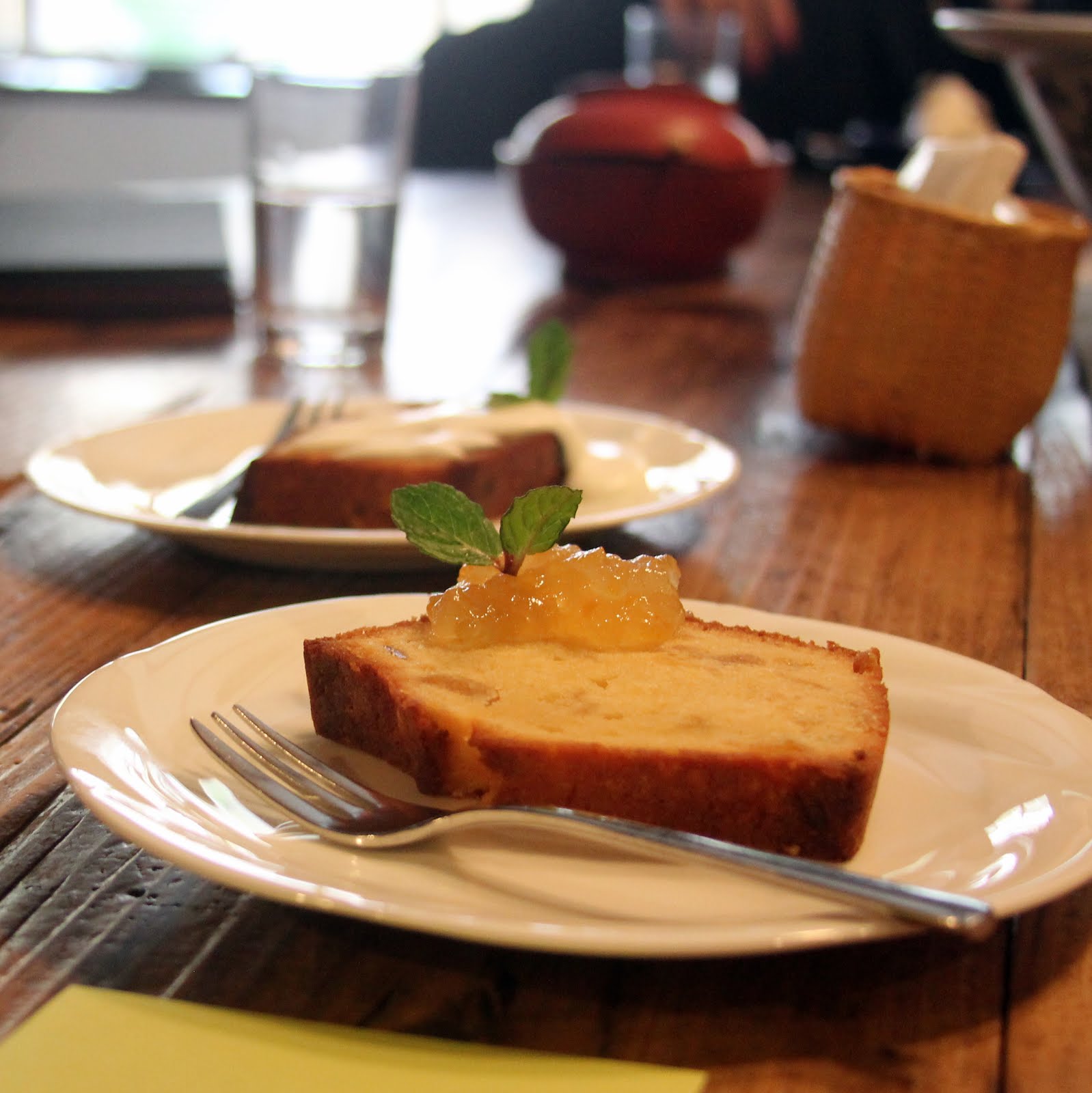
The ume pound cake
We picked up some citrus jam from the ryokan shop and ate it with toast all throughout our trip. It was less like a kitschy American souvenir shop and more like a luxury specialty shop that focused exclusively on regional and seasonal items. I loved browsing through there!

And stepping outside to take in the greenery surrounding this ryokan was magical: the mists swirled around lush greenery, cherry blossoms, and leafy trees. For a Southern California resident used to nothing but drought, it was truly like being transported to a magical forest.

Wednesday, September 7, 2016

Onsen Tamago (温泉卵)

In Beppu, there is a whole cuisine of cooking using the hot steam that erupts from the earth. Called jigokumushi (地獄蒸し), it literally means "hell steaming" which is perhaps my favorite name for a style of cooking, ever. Baskets of food are lowered into the surprisingly powerful steam of the hot springs and a short time later you have fresh produce, thin cuts of meat, and eggs cooked in the steam. There is even a jigokumushi pudding, where a flan is steamed in the mineral-rich steam that jets out of the earth.

I obviously couldn't share a recipe with you on jigokumushi as I don't know about you, but I don't have any hot spring jet steam handy and I think my steamer at home wouldn't be a good substitute. So I am sharing something just as traditional to both Yufuin and Beppu: Onsen Tamago (温泉卵).

Onsen Tamago literally means "hot spring eggs," and as you might have guessed, is named because the eggs are traditionally cooked in hot springs and served at ryokans (inns). Rather than the steam jets of jigokumushi, the eggs still in their shells would be lowered in baskets or nets directly into the hot springs themselves.