Image Map
Showing posts with label umami. Show all posts

Saturday, November 19, 2016

Negima Nabe (ねぎま鍋)

This is an old-school Tokyo recipe. Otoro, or fatty tuna belly, used to be something that spoiled too fast to be commercially useful. Instead of the prized sushi ingredient it is today, it was sold fast and cheap, and more often cooked than served raw, thought to be too rich to consume raw. Which is insane considering how prized and expensive otoro is nowadays. But at one point in time, we used to feed lobsters to prisoners and indentured servants here in the states because it was so plentiful. Doesn't both of these make you wistful?

Our family took us to a restaurant famous for its otoro fare, apparently the royal family has even frequented there. Unfortunately, I wasn't able to track down the name of the restaurant. I wanted to bring some of that cuisine home to Mr. Mochi and my father since they weren't able to come with us on this trip. The name of this hot pot, "Negima Nabe," is a portmanteau the two star ingredients: Japanese long onion "negi" and bluefin tuna "maguro." "Nabe" just means "pot" and refers to the donabe pot that the meal is cooked in. Don't have a donabe? A dutch oven or even a large saucepan will work fine, you might need to cook in batches however.

Friday, November 4, 2016

Yudofu (湯豆腐)

Kyoto, since it was the capital of Japan for so long, is steeped in history and tradition. One of those traditions still popular today is shojin ryori, or Buddhist cuisine. As Buddhism was introduced into Japan in the 6th century, so was the idea of vegetarianism for religious ideals. This cuisine became synonymous with Kyoto as Kyoto is home to some of the longest standing Buddhist temples and sects that still carry on this tradition.

As a whole, Japan is not very vegetarian-friendly. Dashi, made with dried bonito shavings, is omnipresent and veggie dishes on most menus will have some sort of fish in it, if only the broth. If you're a pescetarian, you're in heaven, but if you're vegan or vegetarian, I'm not going to be the best person to tell you how to navigate Japan and I recommend finding a blog that specializes in both Japan and veganism. I ate things in Japan that I'm still not quite sure what I ate, so I'm not going to claim any sort of authority on either subject. I normally write about Japanese American food!

Sunday, October 30, 2016

Nakau (なか卯)

I'm definitely not fluent in Japanese, especially when it comes to the written word. Therefore I amused my relatives by exclaiming excitedly when I actually could read a sign on my trip to Japan. To put this in perspective: imagine if your crazy cousin from another country came to visit you, and every single time you drove past a Little Cesar's, they joyfully bellowed "Pizza!" like they discovered the promised land.

I'm brilliant if I do say so myself.

It doesn't help that my Japanese reading comprehension is all limited to food. I can instantly recognize the characters for donburi (丼), ramen (ラーメン), udon (うどん), curry (カレー)... and not much else without some careful thought.

So I was especially excited to try Nakau (なか卯) as their sign boasted not one, but two words I knew by heart: gyudon and udon. Nakau is a fast food restaurant in Japan famous for their cheap eats with over 400 location. Or perhaps fast casual, not fast food? It's hard to tell in Japan. Anyways, it's very popular with Japanese looking to get a cheap fast meal and I wanted to experience what the quality and price of such a typical chain was.

Saturday, October 8, 2016

Hiroshima-Style Okonomiyaki (広島風お好み焼き)

If you walk into an okonomiyaki joint in Hiroshima and ask for Hiroshima-style okonomiyaki, you might get a funny look. To them, this is simply okonomiyaki and others just have it all wrong.

Hiroshima-style okonomiyaki starts with wheat flour and water, mixed to a thin batter that is cooked over a grill. Shredded cabbage is piled on top as it is halfway through cooking, along with whatever toppings you would like. Yakisoba noodles are put on top, followed by a fried egg.


This entire tower of savory goodness is topped with sauces and served piping hot.

Check out the layers!
What the difference between Hiroshima-style okonomiyaki and the rest of Japan? The more popular style of okonomiyaki mixes the cabbage and eggs directly into the batter rather than stacking them for a thicker okonomiyaki with almost a custardy inside, and most importantly it lacks the noodles.

Okonomiyaki is a Japanese dish that lots of people have tried describing it by attempting to liken it to pizza, but it's nothing like pizza! I liken it more to a Japanese savory cabbage pancake, but it's a little hard to describe even in these respects.
Okonomiyaki, in my opinion, is one of the most accessible foods to those who might be picky or apprehensive about Japanese cuisine. It's a shame that there's a huge lack of okonomiyaki shops in America because everyone who try it seems to love okonomiyaki. I myself actually dislike cabbage, but love this dish. Also in its favor is its nature of customization: okonomiyaki's name itself means "grilled as you like it," and you can add whatever you like to it: squid, seafood, bean sprouts, or anything else that strikes your fancy. For instance, Mr. Mochi loves pork belly and only wants a hint of mayo. No problem! Customization is key.

Wednesday, August 24, 2016

Yawatahama Champon (八幡浜 ちゃんぽん)

It was really hard to decide what to make for Yawatahama. I wanted to bring you something not just uniquely from Shikoku in origin, but Yawatahama itself. However, I was a bit stumped. A lot of what makes Shikoku cuisine unique is the island itself. For instance, the most famous local food of Shikoku is sanuki udon because the island has the best wheat production in Japan. However, that dish hails from Kagawa prefecture, not Ehime prefecture where Yawatahama is located.

Citrus is a huge part of Ehime's agriculture, however I don't have access to the more unique citrus that Japan has. I could do a citrus recipe, even though it's summer and citrus is at its peak in winter, and call it good. But there's not a lot of recipes for citrus that are unique to Ehime because the citrus is normally just eaten simply and the fruit is savored in its original form, and I've already blogged about that. I'd basically be slapping together a marmalade and making a flimsy connection to Yawatahama, something I didn't want to do. I could do a recipe of a nearby city, like Imabari or Uwajima, instead of Yawatahama. I found some awesome regional foods when I researched, however they still weren't strictly from Yawatahama.

I guess I stressed over this so much because I felt so connected to Yawatahama when I visited. My family is buried there. My family lived and died, and continues to live, there. Our creaky old ancestral house stands firmly on its soil. A tiny portion of my soul, my very essence, I think was left on that hilltop surrounded by graves and citrus and the smell of the ocean. A bigger portion was left in that house where I shared tea and smiles with family. It's only natural I wanted to share some of Yawatahama's soul with you.

I'm not normally this cheesy, but truly it was a special experience.

So really, the choice was made for me. If I was going to share a bit of Yawatahama's soul, I was going to have to get serious about creating a dish I've never actually eaten: Yawatahama-style Champon.

Thursday, August 11, 2016

Tomato Miso Soup (丸ごとトマトの味噌汁)

I bring you a break from my Japan adventures to make sure you have a chance to make this soup while tomatoes are in season!

Before we get to the recipe, I wanted to share a funny tidbit about food blogging in general that I really think applies to this recipe. I'm no bullshit. I really don't have the time or energy to pretend life is perfect. I've written about how disastrous I am in the kitchen, and just last week shared how I can't even eat spaghetti or salad without ruining a blouse.


As I've said before, this is isn't one of the more ambitious food blogs, but I'd like to think it's one of the real ones.

I wear an apron not for the fetishized Stepford wife effect, but because I'm really just fucking messy.

So when I set about making this recipe, I was able to make it with my mother's huge bumper crop of heirloom tomatoes. The problem with most heirloom varieties is they are very photo-ready. They tend to crack, have splotchy color, and seem to never be a uniform shape. Not exactly blog-worthy visually, but definitely delicious! But food blogging is about pretty photos. Really, no one cares about what I write up here; we eat with our eyes first. There's a reason Pinterest is popular: we are visual creatures. You can't take my word for it that the ugliest tomato ever is actually delicious. It's gotta look the part.

Some of the wonderful crazy colors!
Therefore I was faced with a choice: make the recipe with grocery store Stepford wife tomatoes, or not-so-pretty heirloom tomatoes? I could even make it with the perfect umblemished grocery store ones for just the photos, then eat the ones from the garden. But that just seemed to venture too far away from my style.

Instead I hosted a casting call of all the ripe heirloom tomatoes from my mother's garden and chose the prettiest ones for my photos! Is it perfectly round? Nope, but it tasted perfect. You'll just have to take my word on it.

Tuesday, August 9, 2016

Kansansoubekkan (観山荘別館)

Our most memorable meal of Fukuoka (and perhaps the enitre trip) was at Kansansoubekkan (観山荘別館), a kaiseki restaurant.

Let us be clear: I am not a kaiseki person and neither is my mother. I'm a fan of donburi, ramen, and mochi. I am solidly a B-class gourmand. My mother is the type of person that got bored in France because every meal took so long.

So kaiseki was a leap for us. For those uninitiated in what kaiseki is: Kaiseki is a multi-course meal that really takes food to an art form.

Only seasonal ingredients, cooked fresh, are used, prepared and plated in a way to highlight not only the taste but the visual appeal of the dish.

We were served 12 different dishes over several hours in a gargantuan private room with just us in it and a view of their beautiful garden. It was a crazy ride, and something I am so glad I was able to experience!

We were sat in a traditional style room, without chairs, but there were several larger parties that elected to sit in a more western banquet style. We took a tour of the garden and took pictures in it, which I don't think most people were allowed to do, because we certainly messed up the pretty gravel designs by walking on it.

Wednesday, July 20, 2016

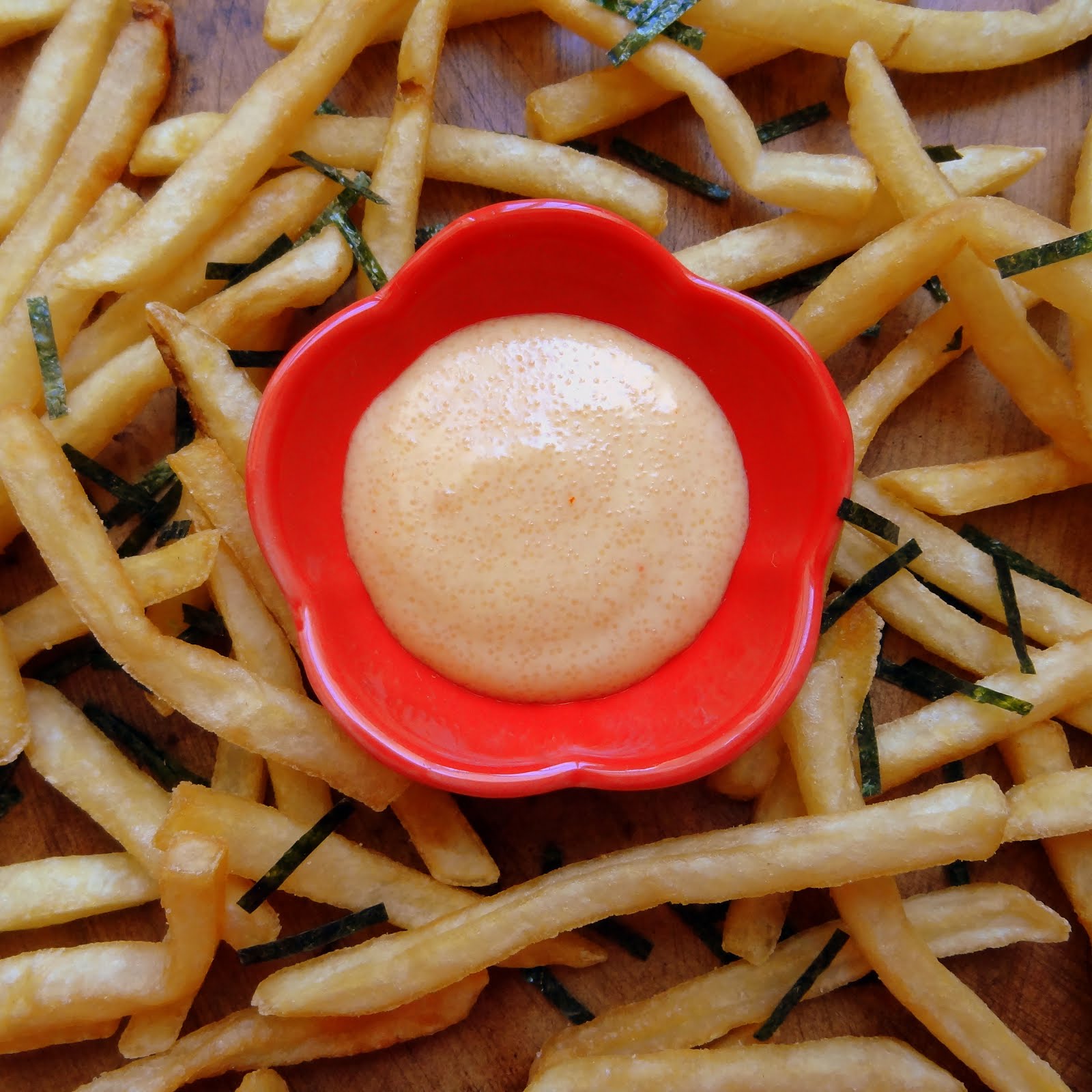
Fries with Mentaiko Mayo Dipping Sauce

Karashi Mentaiko (or usually just called mentaiko) is spicy marinated fermented fish roe (normally cod or pollock) that is a specialty of Kyushu that I introduced as part of my chronicle on my 2014 visit to Japan. Now you may be thinking that there's no way in hell I can marry American tastes with a Japanese product that is as funky, spicy, and fishy as mentaiko. Let me introduce you to my secret weapon: mentaiko mayo.

Mentaiko mayo takes the assertive fish roe and turns it into something creamy and delicious while still maintaining that zing and pop.

photo cred: Creamy Steaks
Mentaiko mayo is so popular there's even a mentaiko mayo Cheetos flavor in Japan, and I'm absurdly disappointed I have not seen or tried it (see here for a review) I love mentaiko mayo's versatility and I believe you will too. It's super easy to whip up, and once you do I think you'll find yourself spreading it on everything.

Some easy ways to enjoy it: spread it on top of baked salmon and broil to finish, mix it in with canned tuna instead of plain mayo for more of a pop, even smear it in a sandwich. But my favorite has to be as a dipping sauce for fries.

Mentaiko

Mentaiko, especially spicy karashi mentaiko, is a specialty of the Hakata ward in Fukuoka City. Mentaiko is fish roe (normally pollock) that is marinated in chili, sake, konbu and yuzu citrus, and then slightly fermented for several hours.

Karashi mentaiko is so popular that usually the term "mentaiko" refers to the type that is spicy, while "tarako" is the regular marinated roe.

Mentaiko is actually originally Korean, as is a lot of the ingredients and dishes that Kyushu is famous for as they are very close to Korea there in the southern regions of Japan.

Mentaiko can be seen traditionally served by itself as a side dish to sake.  It can be eaten raw or cooked (it turns a lighter pink when cooked) and either in its egg sac or removed.

This is how the eggs look removed from the egg sac membrane
One of the more traditional ways you will see it served is over rice with the egg sac intact, where it is often cooked with a bit of oil first. Another traditional use is as a filling for onigiri rice balls or topping sushi, however these days this flavor powerhouse isn't limited to just rice.

You'll find mentaiko incorporated with cream as a delicious pasta sauce, used as way to spice up egg omelettes, baked on top of french bread, mixed into potato salad, spread on top of skewers of chicken, and even as a topping for Japanese pizza! One crazy concoction I love is mochi baked with cheese and mentaiko for a gooey chewy savory-spicy mess.

Here in the states, you can find mentaiko at Japanese grocery stores like Mitsuwa and Marukai. It freezes fairly well, which is good because it's not cheap!

Recipes that use mentaiko:
Fries with Mentaiko Mayo Dipping Sauce

Friday, January 16, 2015

Taberu Rayu English Muffins

This is one of my infamous not-sure-if-it-even-counts recipes because there's really nothing to this recipe. It's more instructions of assembly than a true recipe, but that's the sort of thing I excel at. Some days even the microwave takes too long, you know?

It's no secret I've been in a funk lately. My nature tends towards introspection, analysis, and the esoteric on a good day. That's just the way I am. But sometimes my mind, which most people deem as a gift, lazily spirals into morbidity, melancholy, madness.

The most important thing for anyone to do is simply what they can do now, and not focus on what they could have done. You have to find happiness not tied to measurable things; happiness not tied to titles or success or how you stack up compared to other people. You have to just live.

So fuck it. Let's make some English muffins.

Tuesday, August 26, 2014

Taberu Rayu Cucumbers (きゅうりの食べるラー油)

It's hot here in Southern California, and the drought is so bad I'm almost afraid to do dishes. Rather than relying on fast food, chips and dip while it's too hot to cook, I'm brainstorming healthier, faster, and cooler options for a busy cook.

Like with my Togarashi Zucchini, this is a dish that is a snap to make, and is a great busy weeknight side to serve with something else prepared just as fast or pre-made. Even better, this recipe is a chilled side, which for late summer is a great treat!

This almost isn't a recipe it's that easy, but that also makes it easy to double or triple. It is also a great example of how easy and versatile taberu rayu is: making a super-tasty and healthy veggie side dish in minutes. You can turn cucumbers into a savory spicy powerhouse side with very little effort.

If you want to prep this ahead, chop the cucumber ahead of time and dress right before serving, that way if any water leeches off the cucumber in the fridge, you can drain it before adding the taberu rayu.

Friday, August 22, 2014

Taberu Rayu (食べるラー油)

To explain what Taberu Rayu (食べるラー油) is, I really have to back up and explain what rayu is. Rayu is sesame oil that has been infused with chilies until it is a nice glowing orange-red. It is delicious mixed with vinegar and soy sauce as a dip for gyoza and often seen in ramen shops that serve dumplings.

Taberu Rayu, on the other hand, starts with that same hot chili oil base, but it has crunchy bits in it. Minced fried garlic, fried onion bits, sesame seeds, even bits of almonds are included for a chunky crunchy condiment that can be spooned or mixed into just about anything. On top of ramen, spooned on a bowl of plain rice, even outlandish ideas like putting it on ice cream have surfaced in Japan.

Friday, May 23, 2014

Dami Sushi & Izakaya + GIVEAWAY!

Mr. Mochi and I recently went to a media tasting event for a new izakaya in Orange County, Dami Sushi and Izakaya. Since we love our local izakaya, where you can always grab a cold pint and perhaps a yakitori skewer or two, we were very excited to try another one close by.

Dami Sushi and Izakaya in Buena Park, California, just had their grand opening and invited us to try some of their signature dishes. They also generously donated a $100 gift certificate that you can enter to win below!

I loved the decor and greenery everywhere!
I'm not a big decor person, but the first thing you'll think when you walk in is how cool this place looks. I love the mix of modern technology (the wall above the sushi bar changes color!) with rustic wood and fresh plants. The restaurant also manages to have great airflow, it's breezy in there without us needing a jacket. It also strikes an important balance between atmospheric izakaya lighting and the need for me to see my food. All of these pictures below were taken without any additional lighting, but Mr. Mochi commented that the atmosphere in Dami meant this place was going to be a surefire date place for us.

Especially once we tried the food.

Friday, March 14, 2014

Tamago-Toji Spam Donburi (卵とじ スパム丼)

Unlike katsudon, this donburi does not have a place in Japanese culinary history, it's an original Miss Mochi creation.

This recipe came about when I happened to score a giant pack of low-sodium Spam from Costco and we only had one frozen pre-made tonkatsu left. Since Mr. Mochi is much more fond of pork chops than I am, I made him a katsudon while I decided what sort of rice bowl I should make. I decided to try a Spam and egg donburi, and it turned out so tasty I decided to share it with you.

A donburi is simply a plain rice bowl with toppings, designed as a complete meal. Here in Southern California, Flame Broiler is probably the most popular chain, as well as of course Yoshinoya, which is an amazingly old fast food chain, founded in 1899. Apparently these quick and tasty meals have stood the test of time, because here in 2014 I am obsessed.

I've made a Spam donburi before, and in that post I rambled a bit about all the variations that could be made. You can make a donburi topping out of anything, and I believe the possibilities are endless. I could probably do a Spam donburi month, and still have plenty of ideas at the end of it.

Hey, that is a pretty good idea! Maybe for May?

Until then, here's the latest iteration of Spam donburi.

Sunday, February 16, 2014

Dogzilla

Another food truck that satisfies my love of hapa food: Dogzilla. I am always on a quest to try every crazy mash-up of Asian American cuisine Orange County has to offer. Kimchee quesadillas? Hell yes. Japanese hot dogs? I'm there! Red bean waffle sandwiches? You better believe I even dragged my friends there.

So when I first saw Dogzilla in a Best Buy parking lot, I knew I had to pounce on this one. Unlike a lot of the food trucks I'm in love with, Dogzilla is actually based in Irvine, rather than in L.A. county. And it offers up tasty treats to rival them too.

Dogzilla's tagline, "Not Your Typical Wieners" totally fits because you won't find any mustard or ketchup on their deluxe dogs. Instead, they rely on Japanese flavorings and Hawaiian stand-bys for their unique hot dogs. This isn't exclusive to Dogzilla, the hapa hot dog can be found at places like the Tokyo Doggie Style food truck in LA, Asia Dog in NYC, and Japadog in NYC and Vancouver. I even make a version at home (and why I haven't blogged about this? Fail!).

However trendy, I happen to really love the execution of Dogzilla's hot dogs. Rather than using a normal hot dog bun, they use King's Hawaiian hot dog buns. You can get a fried egg with a gloriously runny yolk on any dog. Their Garlic Fries feature freshly minced garlic rather than garlic powder, making my breath possibly radioactive but I could care less about that when they taste this good.

Monday, February 3, 2014

Setsubun and Ehomaki Recipe!

Today is the day before spring begins according to the lunisolar calendar. On February 3rd, the Japanese celebrate Setsubun, celebrating the start of spring. Setsubun no Hi (節分の日), also known as the Bean-Throwing Festival, celebrates the start of a new year according to the lunar calendar. So several things are done to bring good luck to the coming year, as well as chase away the demons of the old year.

First, is the ritual of mamemaki (節分), which literally translates as bean-throwing, to drive away bad luck and demons (called oni). Usually someone in the family will dress up as a oni and people will stand at the doorway and throw soybeans at the door until the oni retreats. We had way too much fun throwing soybeans at Oni-Tiara, who in turn had way too much fun eating the soybeans.

So now that you've driven out the bad luck and oni (and in our case, attracted a begging pooch), you now eat some soybeans yourself to invite good luck in. Traditionally you eat as many soybeans as your age (Tiara should have stopped at seven beans) but I ended up snacking on them while I wrote this post, so I'm either extra lucky, or more probably, just fatter.

Another ritual is eating ehomaki, a makizuki sushi roll that is completely uncut, and contains 7 different ingredients for good luck. You're supposed to eat it in complete silence while facing a special auspicious direction that changes every year, for instance 2014 the lucky direction is east-northeast.

Now, even if you don't want to eat a whole sushi roll in complete silence, ehomaki are very tasty! They are actually just uncut futomaki, or fat sushi rolls, but it is kinda fun to eat them uncut like a giant sushi burrito. Maki-san at JustHungry has some great ideas for nontraditional ehomaki fillings on this page, as well as the most traditional fillings.

Tuesday, January 28, 2014

Dorilocos: Tostilocos with Doritos

This all started when my coworker shared with me her secret to a happy marriage: on Sundays, she would share a plate of Nacho Cheese Doritos with her husband while they watched television. They always have them served like papitas preparadas, sprinkled in hot sauce and lime juice but with Doritos instead of potato chips. She brought in this snack on a busy day at the office, and offered me a bite.

I was hooked, line and sinker. I have a huge affinity for antojitos, literally "little cravings" or Mexican street food. Except my cravings certainly aren't little by any stretch of the imagination. I've waxed poetic about downtown Los Angeles and the influence of Mexican street food with my L.A. Street Dog post. The same coworker that inspired this recipe was the catalyst for my chile mango candies when she brought in vero mango lollipops. I even used Mexican chocolate and dried chiles for my Christmas gift of caramels.

Now the Doritos are amazingly delicious served the way my coworker introduced me, with lime juice and Valentina hot sauce. But the idea that was planted in my head was something a little more epic: tostilocos with Doritos, or as I named them, Dorilocos.

Tostilocos are a newer antojitos to hit the street food scene. Tostilocos were spawned in border towns like Tijuana around the 1990s, a crazy mixture of salty, sweet, and sour. It's one of those dishes that on paper sound ridiculous, only making sense when you try it yourself. Cucumber, jicama, pickled pork skin (called cueritos), Japanese-style peanuts, hot sauce, chamoy sauce, and even tamarind chewy candies are poured on top of Tostitos chips for a dish that is aptly named loco or "crazy." Here in Orange County, you can find tostilocos at fruit juice shops, or even at swap meets.

Wednesday, January 15, 2014

Katsu Sando (カツサンド)

I know that Japanese cuisine is famous for it's use of unadulterated white rice. Donburi, onigiri, curry rice all use plain white rice. At nearly every meal, white rice is a star player.

However, the Japanese do eat bread, especially in modern times. They even make sandwiches very similar to ours, albeit with some Japanese flair, called "sando" (サンド). Some popular fillings include egg salad or ham, but you may be surprised to see even varieties like fruit sandwiches.


Marukai's Katsu Sando
The best bread for making a sando is shokupan (食パン), which is a soft pillowy bread that is slightly sweet, and manages to be soft while still having a very tight grain that has some stretch and spring to it. Honestly it's kinda like the mochi version of sandwich slices, soft but stretchy. I also like it because it's perfectly square, and you can get it cut thick. I used it in my Milk Toast post; I like it in this recipe because it doesn't compress down into nothingness like regular sliced bread here in America will, but if you don't have access to shokupan and don't feel like baking, I have some alternatives and suggestions for you down below.

Here's a hearty sando using tonkatsu, one which is a snap to make if you make a whole bunch of tonkatsu at once and freeze the extras. This is also good for those of you who don't have a rice cooker, or you too have your own version of Mr. Mochi breathing down your neck while you edit a blog post. (Hence the less than stellar photography, and I actually only had some pretty wimpy cheap white bread around.)

Monday, January 13, 2014

So-su (ソース)

So-su is the Japanese version of Worcestershire sauce, most people here in the states probably know this as "Tonkatsu Sauce" or even just "Bulldog Sauce" as a proprietary eponym (definition). I've heard that it is most similar to HP sauce or A1 Steak Sauce. I haven't tried either of those so I can't personally vouch for those claims. However, it kinda makes sense that HP sauce would be similar, because all of so-su is derived from British influence on Japanese cuisine. Japanese Worcestershire sauce is consider "youshoku" or an item of western-influenced cuisine cuisine.

Where do you usually find so-su? On top of okonomiyaki, tonkatsu, Japanese-style hamburger, yakisoba, and takoyaki, to name a few.

There's actually several different types of so-su, based on how thick it is. "Usuta so-su" is thinnest and most similar to the Worcestershire sauce that the British invent and Americans are familiar with, and the "tokuno or tonkatsu so-su" is very thick and is sweeter and less tangy than the usuta variety. The third is "chuno so-su" which is almost like a blend of the two styles: viscosity in between the other two styles, with a mix of tanginess and fruity sweetness. The type most familiar around the world would be the thickest sauce, the tonkatsu sauce.

Wednesday, December 25, 2013

Katsudon (カツ丼)

Katsudon is definitely a great choice for cold weather. It has a rib-sticking comfort food quality that never fails to satisfy. Filling a bowl with piping hot rice, slipping a crispy crackly fried pork cutlet into a broth bursting with umami and onions, and finally covering everything with a luscious blanket of egg- it only takes minutes if you plan ahead and it is one of the best soul-warming foods, right up there for me with biscuits and gravy.

Now I realize I have very disparate tastes in comfort food, with American Southern cooking competing against Japanese American rice bowls for dominance, but I urge you to give this a try. 

I think the combination of salty fried porky goodness and carbs is universally appealing.

Katsudon is one of the most famous pork dishes in Japan. In fact, if I was being sensible it would have been one of my first blog posts, way before my post on Tonkatsu Karē Donburi. Of course, I don't play by the rules, but really it's a big deal in Japanese casual cuisine. It is even a part of popular culture: in Japanese crime shows, the suspect would be given katsudon to eat in order to make the interrogator seem like a nice fair guy in order to weasel the truth from the suspect.

Another funny anecedote about katsudon is that "katsu" sounds exactly the same as the verb "katsu" (勝つ) which means "to win." This makes this dish popular for sporting teams and students about to take an important test. For example, Hideki Matsui, former World Series MVP for the Yankees, stated in interviews that this was one of his favorite dishes.