Image Map
Showing posts with label veggies. Show all posts

Friday, November 4, 2016

Yudofu (湯豆腐)

Kyoto, since it was the capital of Japan for so long, is steeped in history and tradition. One of those traditions still popular today is shojin ryori, or Buddhist cuisine. As Buddhism was introduced into Japan in the 6th century, so was the idea of vegetarianism for religious ideals. This cuisine became synonymous with Kyoto as Kyoto is home to some of the longest standing Buddhist temples and sects that still carry on this tradition.

As a whole, Japan is not very vegetarian-friendly. Dashi, made with dried bonito shavings, is omnipresent and veggie dishes on most menus will have some sort of fish in it, if only the broth. If you're a pescetarian, you're in heaven, but if you're vegan or vegetarian, I'm not going to be the best person to tell you how to navigate Japan and I recommend finding a blog that specializes in both Japan and veganism. I ate things in Japan that I'm still not quite sure what I ate, so I'm not going to claim any sort of authority on either subject. I normally write about Japanese American food!

Sunday, October 30, 2016

Nakau (なか卯)

I'm definitely not fluent in Japanese, especially when it comes to the written word. Therefore I amused my relatives by exclaiming excitedly when I actually could read a sign on my trip to Japan. To put this in perspective: imagine if your crazy cousin from another country came to visit you, and every single time you drove past a Little Cesar's, they joyfully bellowed "Pizza!" like they discovered the promised land.

I'm brilliant if I do say so myself.

It doesn't help that my Japanese reading comprehension is all limited to food. I can instantly recognize the characters for donburi (丼), ramen (ラーメン), udon (うどん), curry (カレー)... and not much else without some careful thought.

So I was especially excited to try Nakau (なか卯) as their sign boasted not one, but two words I knew by heart: gyudon and udon. Nakau is a fast food restaurant in Japan famous for their cheap eats with over 400 location. Or perhaps fast casual, not fast food? It's hard to tell in Japan. Anyways, it's very popular with Japanese looking to get a cheap fast meal and I wanted to experience what the quality and price of such a typical chain was.

Wednesday, August 24, 2016

Yawatahama Champon (八幡浜 ちゃんぽん)

It was really hard to decide what to make for Yawatahama. I wanted to bring you something not just uniquely from Shikoku in origin, but Yawatahama itself. However, I was a bit stumped. A lot of what makes Shikoku cuisine unique is the island itself. For instance, the most famous local food of Shikoku is sanuki udon because the island has the best wheat production in Japan. However, that dish hails from Kagawa prefecture, not Ehime prefecture where Yawatahama is located.

Citrus is a huge part of Ehime's agriculture, however I don't have access to the more unique citrus that Japan has. I could do a citrus recipe, even though it's summer and citrus is at its peak in winter, and call it good. But there's not a lot of recipes for citrus that are unique to Ehime because the citrus is normally just eaten simply and the fruit is savored in its original form, and I've already blogged about that. I'd basically be slapping together a marmalade and making a flimsy connection to Yawatahama, something I didn't want to do. I could do a recipe of a nearby city, like Imabari or Uwajima, instead of Yawatahama. I found some awesome regional foods when I researched, however they still weren't strictly from Yawatahama.

I guess I stressed over this so much because I felt so connected to Yawatahama when I visited. My family is buried there. My family lived and died, and continues to live, there. Our creaky old ancestral house stands firmly on its soil. A tiny portion of my soul, my very essence, I think was left on that hilltop surrounded by graves and citrus and the smell of the ocean. A bigger portion was left in that house where I shared tea and smiles with family. It's only natural I wanted to share some of Yawatahama's soul with you.

I'm not normally this cheesy, but truly it was a special experience.

So really, the choice was made for me. If I was going to share a bit of Yawatahama's soul, I was going to have to get serious about creating a dish I've never actually eaten: Yawatahama-style Champon.

Thursday, August 11, 2016

Tomato Miso Soup (丸ごとトマトの味噌汁)

I bring you a break from my Japan adventures to make sure you have a chance to make this soup while tomatoes are in season!

Before we get to the recipe, I wanted to share a funny tidbit about food blogging in general that I really think applies to this recipe. I'm no bullshit. I really don't have the time or energy to pretend life is perfect. I've written about how disastrous I am in the kitchen, and just last week shared how I can't even eat spaghetti or salad without ruining a blouse.


As I've said before, this is isn't one of the more ambitious food blogs, but I'd like to think it's one of the real ones.

I wear an apron not for the fetishized Stepford wife effect, but because I'm really just fucking messy.

So when I set about making this recipe, I was able to make it with my mother's huge bumper crop of heirloom tomatoes. The problem with most heirloom varieties is they are very photo-ready. They tend to crack, have splotchy color, and seem to never be a uniform shape. Not exactly blog-worthy visually, but definitely delicious! But food blogging is about pretty photos. Really, no one cares about what I write up here; we eat with our eyes first. There's a reason Pinterest is popular: we are visual creatures. You can't take my word for it that the ugliest tomato ever is actually delicious. It's gotta look the part.

Some of the wonderful crazy colors!
Therefore I was faced with a choice: make the recipe with grocery store Stepford wife tomatoes, or not-so-pretty heirloom tomatoes? I could even make it with the perfect umblemished grocery store ones for just the photos, then eat the ones from the garden. But that just seemed to venture too far away from my style.

Instead I hosted a casting call of all the ripe heirloom tomatoes from my mother's garden and chose the prettiest ones for my photos! Is it perfectly round? Nope, but it tasted perfect. You'll just have to take my word on it.

Tuesday, August 9, 2016

Kansansoubekkan (観山荘別館)

Our most memorable meal of Fukuoka (and perhaps the enitre trip) was at Kansansoubekkan (観山荘別館), a kaiseki restaurant.

Let us be clear: I am not a kaiseki person and neither is my mother. I'm a fan of donburi, ramen, and mochi. I am solidly a B-class gourmand. My mother is the type of person that got bored in France because every meal took so long.

So kaiseki was a leap for us. For those uninitiated in what kaiseki is: Kaiseki is a multi-course meal that really takes food to an art form.

Only seasonal ingredients, cooked fresh, are used, prepared and plated in a way to highlight not only the taste but the visual appeal of the dish.

We were served 12 different dishes over several hours in a gargantuan private room with just us in it and a view of their beautiful garden. It was a crazy ride, and something I am so glad I was able to experience!

We were sat in a traditional style room, without chairs, but there were several larger parties that elected to sit in a more western banquet style. We took a tour of the garden and took pictures in it, which I don't think most people were allowed to do, because we certainly messed up the pretty gravel designs by walking on it.

Friday, July 22, 2016

Mizuna (水菜)

Mizuna (水菜) is a green that you will see called by a lot of different names here in the states: Japanese mustard, potherb mustard, even California peppergrass or the wildly ambiguous "Japanese greens." I like sticking to the name Mizuna because I think those other names are a bit misleading. Mizuna isn't that peppery and it's certainly not mustardy despite being in the mustard family. The name "mizuna" literally means "water greens" which refers to its juicy stems.

I'd peg the taste of mizuna as plesantly crisp, very mildly peppery (much less than arugula), with a bit of earthiness in the leaves. I'm not a fan of frisee or arugula because they tend to overwhelm so many other flavors, but I find mizuna to have just enough kick and bitterness for me. I also love that you can use the stems just as well as the leaves in most dishes without trimming as they are just as mild as the leaves.

Actually, you've probably already eaten mizuna and just not realized it! Baby mizuna is a popular green to be in a mesclun or spring salad mixture. Especially here in California, you can often find baby mizuna alongside other greens in a mixed salad.

Feel free to use those juicy stems! They aren't overly bitter at all!
In Japanese cooking, you will find mizuna most commonly pickled, simmered, or added to a hot pot dish rather than a salad. Now if you ever come across a recipe for a cooked mizuna dish and it seems like they got the amount wrong--they couldn't possibly mean to add that much in--don't worry as it cooks down quite a bit.

It is a very cool weather friendly plant, which is why you will see it added to a lot of hot pots. Especially in the winter months when you crave a hot pot, traditionally there weren't a lot of leafy greens to choose from.

How to use mizuna? Any way you would use arugula you can substitute mizuna (especially if you're like me and think arugula is a little too feisty sometimes). Try some tossed with balsamic vinaigrette, strawberries, crumbled feta and walnuts for a salad, or sauteed like spinach next to a roast. My mother likes to sneak all sorts of homegrown greens into her sandwiches, so I often stuff some into my Caprese Sandwich recipe. I think a BMT (bacon, mizuna, tomato) would be equally delicious!

Recipes that feature mizuna:
Ozoni
Mizuna, Apple, and Jicama salad with Yuzu Kosho Vinaigrette 
Caprese Sandwich

Tuesday, August 26, 2014

Taberu Rayu Cucumbers (きゅうりの食べるラー油)

It's hot here in Southern California, and the drought is so bad I'm almost afraid to do dishes. Rather than relying on fast food, chips and dip while it's too hot to cook, I'm brainstorming healthier, faster, and cooler options for a busy cook.

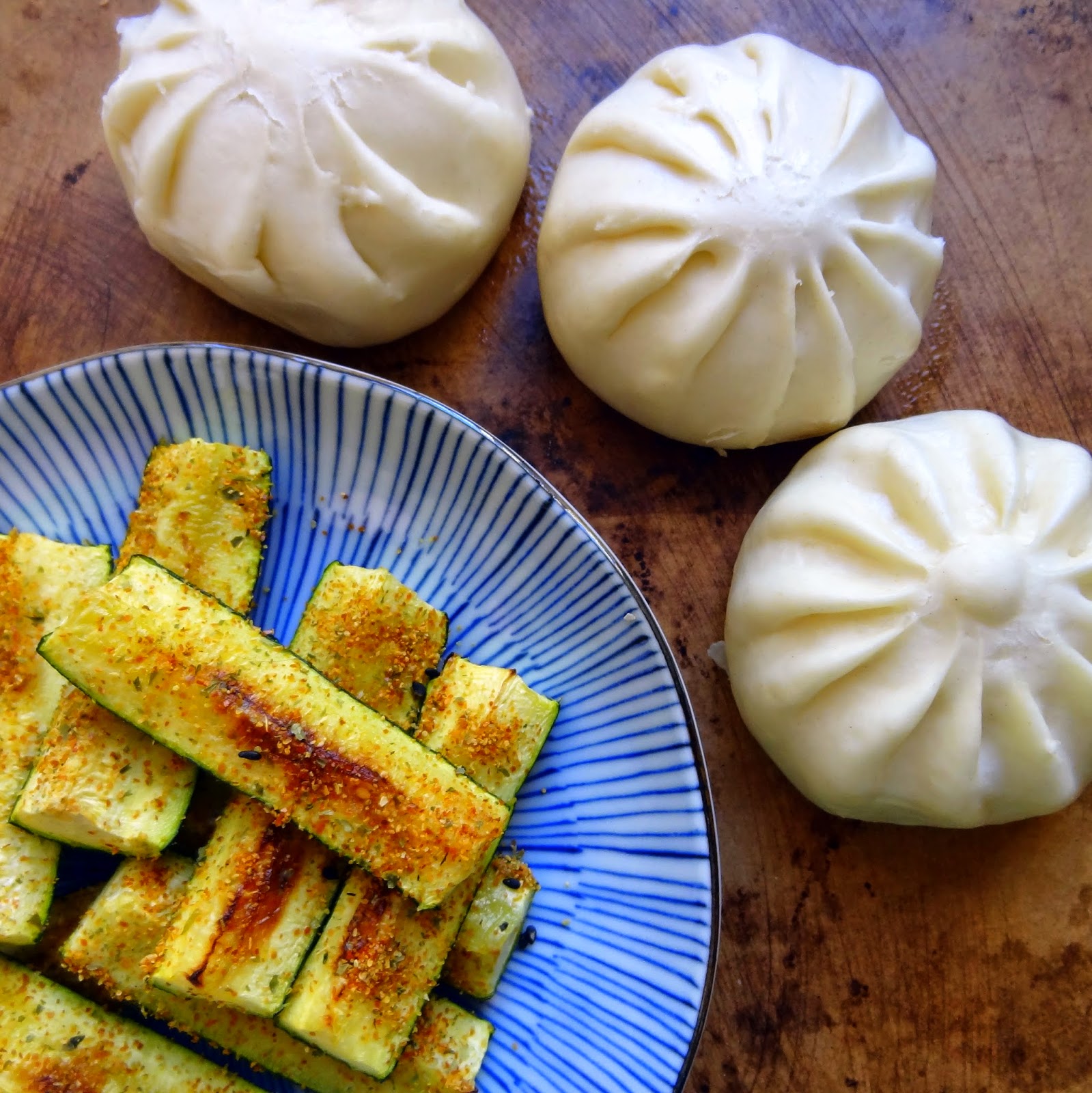
Like with my Togarashi Zucchini, this is a dish that is a snap to make, and is a great busy weeknight side to serve with something else prepared just as fast or pre-made. Even better, this recipe is a chilled side, which for late summer is a great treat!

This almost isn't a recipe it's that easy, but that also makes it easy to double or triple. It is also a great example of how easy and versatile taberu rayu is: making a super-tasty and healthy veggie side dish in minutes. You can turn cucumbers into a savory spicy powerhouse side with very little effort.

If you want to prep this ahead, chop the cucumber ahead of time and dress right before serving, that way if any water leeches off the cucumber in the fridge, you can drain it before adding the taberu rayu.

Saturday, June 28, 2014

Togarashi Zucchini

I like creating simple recipes that take little time or effort to make. Sure, sometimes I mix things up with a more-involved recipe, but most of the time my ideas are ludicrously simple.

Like most of you, I'm willing to wager, I've got a Pinterest full of very ambitious ideas I really just don't have time for. But they are inspiring, and I love browsing through and finding these bloggers who invest some serious time into creating amazing things.


This blog isn't one of the ambitious ones. But I'd like to think it's one of the real ones.

I work full-time in a very physically and emotionally draining career. When you've had to wrestle an aggressive 130lbs dog and euthanize someone's childhood friend within 20 minutes of clocking in to your shift, it's hard at the end of the day to want to prepare anything for dinner.

Most workdays, I have to have dinner done in less than 10 minutes (including clean-up) or it just won't happen. Especially when I get off work at 9:30pm and have to be back at 7:30am.

Therefore I rely a lot on easy-to-make entrees, pre-made sides, and fresh veggies that require no preparation in order to get things on the table fast. Here's one of my go-to sides that requires
little-to-no clean up and is healthy to boot!

Sunday, July 29, 2012

Bacon Corn Chowder

This recipe has no exotic Japanese American ingredients. It's all American. As I've said in my Southern biscuits and gravy post, I am heavily influenced by the way the women who raised me cooked, which was my Japanese American grandmother and mother. However, I do switch it up and cook Southern, New Mexican, and American Indian once in a while.

While traditional American Indian food is for another post, it is funny to think about the American Indian influences on modern cuisine today.  Already pish-poshing?  How you liking your popcorn at the movies?  Corn cultivation and domestication is all thanks to the indigenous people of the Americas. We tend to forget when we sit down to beans, sweet potatoes, cranberry, and turkey every year, but American Indian influences go beyond Thanksgiving.

And let's not forget the potato, which may seem like an old European staple, was brought back from the Americas by the Spanish.

In fact, according to What's Cooking America, the first chowders in America were eaten by American Indians. However, you cannot necessarily say that they introduced Europeans to chowder, because chowders are in every culture.

Bacon and pigs, however, was introduced to the Americas, and made it a better place. hehe!