Image Map
Showing posts with label winter. Show all posts

Sunday, December 18, 2016

Mulled Wine Stuffing with Sausage and Chestnuts

Here's another special holiday family recipe from my mother that I had to make sure I learned how to make. This stuffing is possibly my favorite culinary aspect of the holiday season!

I love how the wine gives this stuffing acidity and a little bit of bitterness to cut through the richness of butter, sausage and bread. Most stuffings can be be a little stodgy and bland, and the use of the mulled wine brightens it up.

I've written about this stuffing on my slow cooker mulled wine recipe, as that is the ingredient that really makes this stuffing.You can add in dried fruit or nuts, or remove the meat entirely. It will still be acceptable to me. However, if you omit the mulled wine, it just won't taste right in my book. This is the only stuffing for me!

Now, the big trend for food photography for stuffing is giant pieces of bread that toast up nicely in the oven and make for a glorious picture, however I don't think that tastes as nice because everything doesn't have a chance to incorporate. If you prefer a drier stuffing, reduce the liquid to 1 cup each of broth and mulled wine. I like mine nice and mushy and don't really care if that's not as attractive to photograph. 

Sunday, September 11, 2016

Tenjosajiki Cafe (天井桟敷)

After leaving Beppu, we drove up and down mountains to reach Yufuin. We stopped by Yufuin on our way back to Yawatahama for a quick visit so our relatives could show us more of Kyushu.

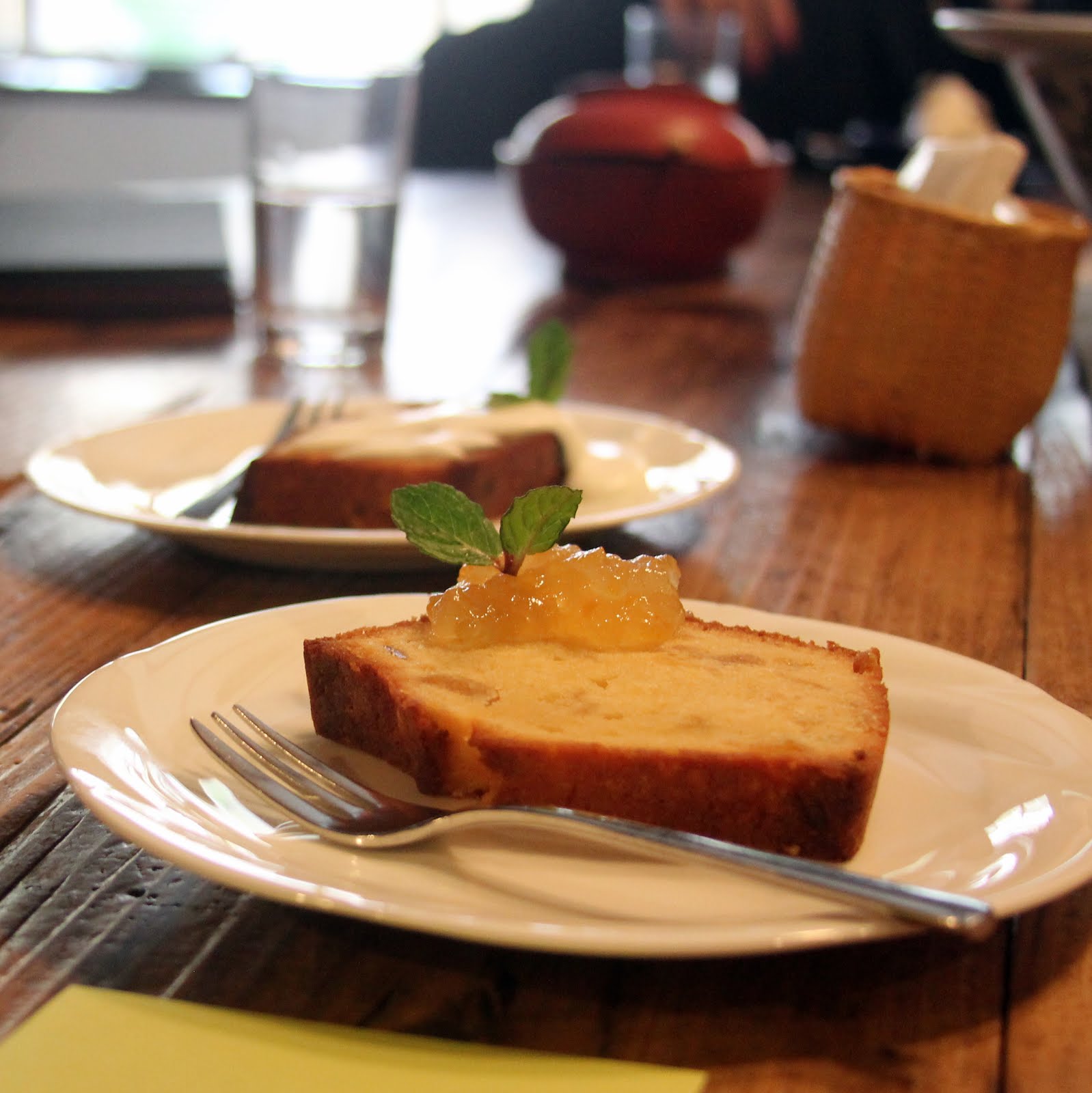
While in Yufuin, we stopped by Kamenoi Bessou (亀の井別荘) a ryokan (inn) that included hot springs, a wonderful souvenir shop, and a restaurant space upstairs that was a cafe during the day and a bar after 7pm, called Tenjosajiki Cafe and transforming into Yamaneko (山猫) at night.

The ume pound cake
We picked up some citrus jam from the ryokan shop and ate it with toast all throughout our trip. It was less like a kitschy American souvenir shop and more like a luxury specialty shop that focused exclusively on regional and seasonal items. I loved browsing through there!

And stepping outside to take in the greenery surrounding this ryokan was magical: the mists swirled around lush greenery, cherry blossoms, and leafy trees. For a Southern California resident used to nothing but drought, it was truly like being transported to a magical forest.

Tuesday, January 20, 2015

Salted Nut Bars

Best. Cookie. Ever.

No seriously, I'm not the biggest fan of sweets, but this bar cookie rocks. It's an old family recipe that was obviously way ahead of its time because now treats like salted caramel and sea salt desserts are all the rage.

When we used to go up to a cabin in Big Bear Lake, CA to snowboard, my mother would bring these cookies to serve for dessert after her infamous turkey soup. These freeze amazingly, and you can just zap them for a couple seconds to thaw them, or even just wait for your coffee to cool down a bit and they will be edible by then. I just gnaw on them frozen.

Shown here with my Peppermint Sugar Cookies
I love bar cookies because I really hate using a rolling pin. If you look, I haven't included a single recipe that uses one in all my years of blogging. I just don't have the counter space here in my little shit hole of an apartment, and it's a bother. Plus bar cookies are less time consuming to make large batches without having to form cookies. And you never have to worry that you overcrowded the cookies and your cookies will turn out funny shaped as they spread.

Bar cookies are for smart but lazy people, basically.

Tuesday, January 13, 2015

Slow Cooker Mulled Wine

Some of these recipes on this blog are really for my own use. I needed to record them in some lasting way so that way I would be able to recreate them. My mother's Turkey and Hominy Soup, for instance, is a behemoth of a recipe that really stands out like a sore thumb compared to my usual repertoire.

I like simple and fast recipes that usually feed one or two people. Her recipe uses a twenty pound roast turkey and six pounds of hominy to start.

Her recipe takes two days to make normally (one to roast the turkey, another to simmer the bones all day to make the broth), while most of my recipes take less than 30 and some can barely be called "recipes" but more "mildly fun food ideas" in actuality.

So why do I feel the need to record these recipes that really aren't my style? Because someday my mother won't be able to make them. Some day it will be just me in charge of holiday celebrations, and I will be lost as how to capture the nostalgia.

Wednesday, May 14, 2014

Kumquat Tofu Cheesecake

I'm sad winter is over and spring is soon to follow. I love winter because it means our citrus trees start producing, and from winter to the start of spring we get our crop of kumquats, oranges, and tangelos. This year, some unseasonable winds knocked down what remained of our kumquat crop, so I'm glad I got to make this cake for my mother's birthday before that happened!

Don't let the name scare you, this tofu cheesecake isn't a health food. However, it retains that creaminess that you love about cheesecake, while boasting a lot more protein than a traditional cheesecake. I bet you if you chose to stay mum about the fact it was packed with protein, your guests wouldn't even know it had tofu in it. It's also a bake-free cheesecake, which is great since we are having a serious heat wave here in Southern California.

If you don't have access to kumquats, you could serve this with no topping at all, or any fresh fruit that you choose. I think blueberries, strawberries, or raspberries would be a great topping choice! Of course, if you have any jars of kinkan no kanroni in your cupboard, you're good to go.

This recipe is adapted from recipes who use the metric system and different size cups, so while I converted the recipe, I also included some weights where applicable because it's more accurate.

Tuesday, January 21, 2014

Reito Mikan (冷凍みかん)

Exciting news! I am visiting Japan this spring! I can't wait to share the experience on my blog! This is my first time visiting, so I am absolutely thrilled to finally be going! It's going to be a bit of a budget trip, so expect a lot of pictures of 7-11 bento boxes.

One of the places I will be visiting is my family's ancestral home on Shikoku (四国). Shikoku is the smallest of the four major islands of Japan, and is considered the most rural. Most tourists never set foot there, I guess you could say it's kinda like visiting Wyoming instead of New York here in the states.

Within Shikoku, I will be heading specifically to Ehime Prefecture's Yawatahama city. Ehime Prefecture (愛媛県) is the largest producer of citrus in Japan and Yawatahama (八幡浜市) is especially known for its citrus as well as its harbor.

Shikoku island in brown*
I find it slightly hilarious that my Japanese side of the family lives there, since I hail from Orange County, CA and grew up surrounded by a citrus grove.

One of their biggest crops is mikan (蜜柑 or みかん) also known as the satsuma mandarin. These diminutive fruits resemble clementines (marketed here as "Cuties") in their small size, but their bumpy loose skin with large pores make the mikan look more rustic. I love these seedless wonders, especially their lack of pith and easy-to-peel skin.

So until I finally set foot in the Land of the Rising Sun, I'll be trying to share some Shikoku specialties! First up is a fun quick snack, reito/reitou mikan, which is actually popular all over Japan. There's even a crazy song about reito mikan.

Tuesday, December 31, 2013

The New Year: Toshikoshi Soba (年越しそば)

I seriously cannot believe it's New Year's Eve. Can I please go back to being a kid again?

Maybe I'm not cut out for the world of food blogging, alongside the multitude of smiling happy women writing their upbeat prose; prose that makes you want to whip out an apron and spatula just to capture some of that bliss, some of that contentment with life that seems to emanate from their words.

I can't do it.


On a good day, I'm endearingly neurotic, making godzilla-worthy messes out of my kitchen, introspective and analytical to a fault. On other days, I'm fickle, wrathful, and dangerously unstable, capable of destroying people in a single spiteful sentence.

I am human, I am imperfect, I am flawed.

Right now, I'm Alice, falling down the rabbit hole. When did the years start to fly by so fast?

There's so much left undone.

I guess, given my mood, that it's ironic that some translate "Toshikoshi" as meaning "killing off the year."

Toshikoshi soba is traditionally eaten on New Year's Eve in Japanese culture as a way of ending the old year and beginning the new year. The long noodles are a prayer for longevity, and traditionally soba is used because it is easier to bite through cleanly than udon, representing a clean cut leaving behind the bad of the last year and going fresh into the new year.

Saturday, November 30, 2013

Turkey and Hominy Soup

This recipe is legend among our family and family friends. Every fall and winter, my mother makes several giant batches to dole out with crusty bread on cold nights. My mother refers to it simply as "Turkey Soup," but in reality it is so stuffed with ingredients it's hardly a soup anymore. The way my mother cooks is to generally clear out her fridge, chucking things in until she thinks it "smells right" so this isn't exactly a recipe that was easy to write down, but it is certainly one that it is tailor-made for alterations.


Don't like hominy? Well I think you're nuts, but feel free to replace them with some kidney beans, or whatever strikes your fancy (or you have in your cupboard).

I happen to love hominy in a big way, it's always been my favorite part of this soup. For those of you not familiar with hominy, it is corn that has been treated with lye making it puffy and delicious in a process called nixtamalization. It is the precursor to masa, the ground corn dough that makes up tortillas, tamales, and papusas. The name "hominy" comes from the Powhatan tribe of American Indians, and many traditional American Indian diets included hominy.

Look how big that can is! IPhone for size comparison.
This recipe is very typical of my mother's cooking, almost spartan in its preparation. No added salt, no added fats, no giant mess of spices. While the stock is made in a French manner, with the classic mirepoux of celery, onion, and carrots, one could see a lot of Japanese American influences even in her Western-style cooking. The mottainai "waste-nothing" attitude behind using the leftover turkey bones to make her own stock and clearing out the cupboards and fridge for a soup that is always changing depending not only on the season but the very day she cooks it, for example.

Tuesday, January 1, 2013

Happy New Year! Ozoni Recipe!

Happy New Year everyone! I hope everyone had a good 2012 and will have an even better 2013!

My family drove up to my great uncle's house to eat ozoni, mochi soup that is traditionally eaten as the first meal of the new year in Japanese culture. Oshogatsu, as the New Years celebration is called, is the most important holiday of the year in Japanese culture. Instead of just celebrating from the 31st to the 1st, Oshogatsu celebrations can extend from December the 28nd to January 6th!

My mom got me this kagami mochi for my place!
Mochi plays an important part, not only for eating, but also as decoration. Kagami mochi (鏡餅), or mirror mochi, has a place in the household as a good luck charm and a symbol of the coming and going years. The two giant mochi disks are topped traditionally with a daidai tangerine, but as a kid I loved the ones with the zodiac animal on top. Of course, while displaying mochi is fun and all, it is much more auspicious to eat it in ozoni.

2013 is the year of the snake
Ozoni (お雑煮), or zoni, has been a New Years tradition since around 1400-1500 A.D. It was originally a samurai battle food, using dried mochi cakes and dry goods that they could carry around with them and then prepare on the field of battle by adding water and whatever fresh greens they could rustle up, then making a stew. Somehow, it became a food of the common man, and later a traditional and lucky meal for Oshogatsu.

As a kid, I didn't particularly like ozoni. I remember watching the mochi get put in the broth and thinking what a waste of perfectly good mochi! I preferred my mochi to be sweet rather than savory, and I didn't like all the vegetables interfering with my carbohydrate overload.

New hashi for the new year!
Now that I'm older, I really love ozoni. The bitter mizuna greens, complex earthy dashi, silky-soft tofu, and sweet mochi, with all their different textures and tastes, are ingredients that are disparate in nature, but come together as just simple and comforting. My great uncle jokes it's great hangover food after a rough New Year's Eve celebration.

Ozoni, like oden, is a dish that varies wildly from household to household. Some boil the mochi in the broth, while others toast them before adding them to the soup. In the Tokyo region, they use a dashi based broth, whereas in the Kansai region they use a white miso broth. Coastal regions favor more seafood, while mountainous regions traditionally used more taro.

These dishes steeped in tradition, that incorporate your family and upbringing, are my favorite type of food.

Sunday, December 16, 2012

Raya at the Ritz-Carlton

Miss Mochi goes fine dining! No seriously, its a rarity. I need a monocle and a top hat, stat.

For my dad's birthday, we went to Raya at the Laguna Niguel Ritz-Carlton, and I couldn't resist sharing everything with you. In fact, I think our waiter thought my mother was crazy, with her huge camera snapping pictures of everything.

Per the official website, "Raya, named “Restaurant of the Year” by Riviera Orange County in July 2011, is a restaurant concept by acclaimed Chef Richard Sandoval. Raya showcases Pan-Latin Coastal Cuisine prepared with sustainable seafood, local produce, natural and organic meat and Chef Richard Sandoval’s signature Latin flavors."

Yes, there were plenty of Latin flavors, but also a lot of Japanese influences too, with togarashi, kabayaki, and even ramen noodles on the menu. The thing that annoyed me the most, being a possibly anal former English major but also a Japanese American was the fact that "shishito peppers" was labeled as "sushito peppers" on the menu. You'd think such a fancy establishment that touts itself as such could afford a fact-checker.

Okay, had to get that off my chest.

Top: Mr. Mochi, Mom, Brother. Bottom: Miss Mochi, Grandma, Dad

Saturday, December 8, 2012

Oden (おでん)

I have been so excited, waiting for the temperature to drop. It's been so hot this fall, that I've been dreaming of sweaters, hot apple cider, and my favorite cool weather Japanese foods while wearing shorts and sandals and bemoaning the overbearing sun.

Apparently Southern California weather has some serious flaws when you love winter.

Around this time of year, oden starts popping up on menus at izakayas and other Japanese restaurants. A hot pot hodgepodge of fish cakes, tofu, daikon, and more simmered in broth, oden is a soul warming comfort food similar to tomato soup and a grilled cheese here in America. When it rains, it's always a toss up between oden and my mom's turkey soup.

My fish cake heavy version
The thing I love best about oden is that everyone does it differently. In the Shizuoka area, the dark heady broth is flavored with beef and dark soy and everything is on skewers. Conversely, Western Japan favors a lighter dashi broth, and in the Nagoya area it is made with miso. Even convenience stores will have oden, and you can get it canned out of vending machines!

Oden is one of those wonderful dishes that everyone makes different depending on what you grew up with.
From wiki, check out this epic oden!

The first time I had oden, I called it "fish cake soup" because I had no clue what it was called.

The nice thing is that everything tastes better the longer it's simmered, and it is even better the next day reheated. So for New Year's my family would have a crockpot with oden warming up on a side board, a perfect dish to make ahead and reheat for the party.

You can add whatever you want to your oden. I have a recipe at the end, but it is really up to you. There are premade oden sets in the Japanese markets, feel free to go with these until you decide which additions you like, then pick out your own! The most common ingredients are daikon radish, hard-boiled eggs, chikuwa and other fish cakes, konnyaku, and tofu- both fried and fresh. The more unusual and regional ingredients include beef tendon, octopus, and pig trotters!