Image Map

Friday, July 22, 2016

Mizuna (水菜)

Mizuna (水菜) is a green that you will see called by a lot of different names here in the states: Japanese mustard, potherb mustard, even California peppergrass or the wildly ambiguous "Japanese greens." I like sticking to the name Mizuna because I think those other names are a bit misleading. Mizuna isn't that peppery and it's certainly not mustardy despite being in the mustard family. The name "mizuna" literally means "water greens" which refers to its juicy stems.

I'd peg the taste of mizuna as plesantly crisp, very mildly peppery (much less than arugula), with a bit of earthiness in the leaves. I'm not a fan of frisee or arugula because they tend to overwhelm so many other flavors, but I find mizuna to have just enough kick and bitterness for me. I also love that you can use the stems just as well as the leaves in most dishes without trimming as they are just as mild as the leaves.

Actually, you've probably already eaten mizuna and just not realized it! Baby mizuna is a popular green to be in a mesclun or spring salad mixture. Especially here in California, you can often find baby mizuna alongside other greens in a mixed salad.

Feel free to use those juicy stems! They aren't overly bitter at all!
In Japanese cooking, you will find mizuna most commonly pickled, simmered, or added to a hot pot dish rather than a salad. Now if you ever come across a recipe for a cooked mizuna dish and it seems like they got the amount wrong--they couldn't possibly mean to add that much in--don't worry as it cooks down quite a bit.

It is a very cool weather friendly plant, which is why you will see it added to a lot of hot pots. Especially in the winter months when you crave a hot pot, traditionally there weren't a lot of leafy greens to choose from.

How to use mizuna? Any way you would use arugula you can substitute mizuna (especially if you're like me and think arugula is a little too feisty sometimes). Try some tossed with balsamic vinaigrette, strawberries, crumbled feta and walnuts for a salad, or sauteed like spinach next to a roast. My mother likes to sneak all sorts of homegrown greens into her sandwiches, so I often stuff some into my Caprese Sandwich recipe. I think a BMT (bacon, mizuna, tomato) would be equally delicious!

Recipes that feature mizuna:
Ozoni
Mizuna, Apple, and Jicama salad with Yuzu Kosho Vinaigrette 
Caprese Sandwich

Wednesday, July 20, 2016

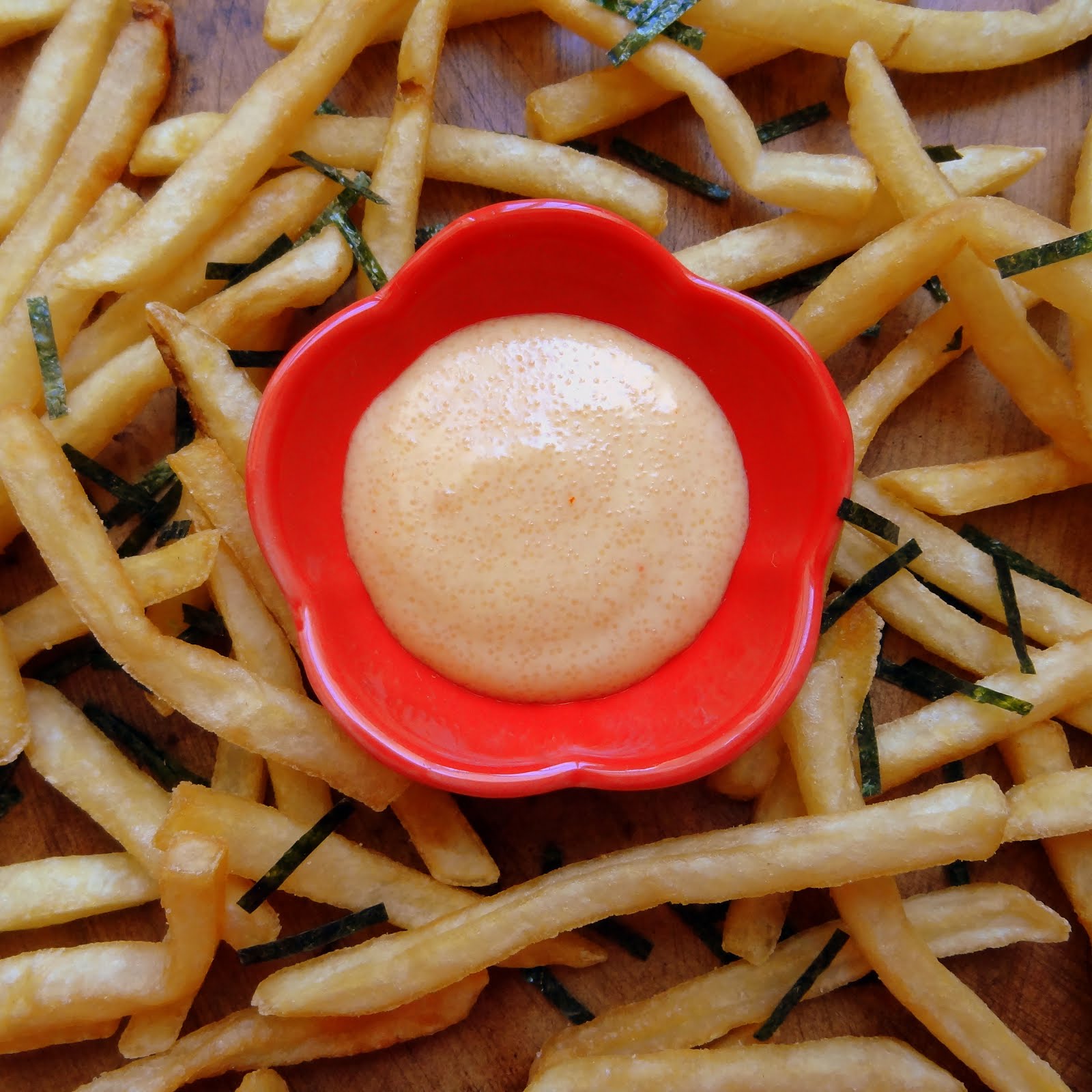
Fries with Mentaiko Mayo Dipping Sauce

Karashi Mentaiko (or usually just called mentaiko) is spicy marinated fermented fish roe (normally cod or pollock) that is a specialty of Kyushu that I introduced as part of my chronicle on my 2014 visit to Japan. Now you may be thinking that there's no way in hell I can marry American tastes with a Japanese product that is as funky, spicy, and fishy as mentaiko. Let me introduce you to my secret weapon: mentaiko mayo.

Mentaiko mayo takes the assertive fish roe and turns it into something creamy and delicious while still maintaining that zing and pop.

photo cred: Creamy Steaks
Mentaiko mayo is so popular there's even a mentaiko mayo Cheetos flavor in Japan, and I'm absurdly disappointed I have not seen or tried it (see here for a review) I love mentaiko mayo's versatility and I believe you will too. It's super easy to whip up, and once you do I think you'll find yourself spreading it on everything.

Some easy ways to enjoy it: spread it on top of baked salmon and broil to finish, mix it in with canned tuna instead of plain mayo for more of a pop, even smear it in a sandwich. But my favorite has to be as a dipping sauce for fries.

Mentaiko

Mentaiko, especially spicy karashi mentaiko, is a specialty of the Hakata ward in Fukuoka City. Mentaiko is fish roe (normally pollock) that is marinated in chili, sake, konbu and yuzu citrus, and then slightly fermented for several hours.

Karashi mentaiko is so popular that usually the term "mentaiko" refers to the type that is spicy, while "tarako" is the regular marinated roe.

Mentaiko is actually originally Korean, as is a lot of the ingredients and dishes that Kyushu is famous for as they are very close to Korea there in the southern regions of Japan.

Mentaiko can be seen traditionally served by itself as a side dish to sake.  It can be eaten raw or cooked (it turns a lighter pink when cooked) and either in its egg sac or removed.

This is how the eggs look removed from the egg sac membrane
One of the more traditional ways you will see it served is over rice with the egg sac intact, where it is often cooked with a bit of oil first. Another traditional use is as a filling for onigiri rice balls or topping sushi, however these days this flavor powerhouse isn't limited to just rice.

You'll find mentaiko incorporated with cream as a delicious pasta sauce, used as way to spice up egg omelettes, baked on top of french bread, mixed into potato salad, spread on top of skewers of chicken, and even as a topping for Japanese pizza! One crazy concoction I love is mochi baked with cheese and mentaiko for a gooey chewy savory-spicy mess.

Here in the states, you can find mentaiko at Japanese grocery stores like Mitsuwa and Marukai. It freezes fairly well, which is good because it's not cheap!

Recipes that use mentaiko:
Fries with Mentaiko Mayo Dipping Sauce

Sunday, July 17, 2016

Uomoto Style Kare: An Updated Post!

I'm guessing people who don't know me in real life probably wonder if I've died, based on the last time I posted. I've had quite the whirlwind adventure since my last post, but that's a story for another time.

Here's a pretty old recipe by this blog's standards: the original post was over four years ago! The picture was so bad it didn't even look like the finished product! So I made it again, and made sure to snap some better photos. Check it out here.

One thing I forgot to mention in the original post about the ingredients: not only are frozen peas faster than having to peel, dice, and boil potatoes, but they are much lower on the glycemic index! According to Harvard Health, russett potatoes have over eight times the glycemic load than peas per average serving. So not only is my version resourceful, but healthier!

Note on the pictures: Japanese curry seems to drink up light, and I probably should have had the curry facing the indirect sunlight rather than the rice to help lighten it up. Japanese curry just isn't the most attractive dish and I'm no expert photog. And no, a clumsy editing process did not turn that rice golden. It's haiga-mai, or half-milled rice. It cooks up similar to white rice, but it's supposedly healthier. I like its delicate sweet nutty flavor that doesn't overwhelm like brown rice can.

Sunday, August 23, 2015

Bacon Wrapped Mochi (餅の豚巻き)

I love mochi.

I've written odes to mochi.

My last meal on earth would involve mochi. Possibly several courses of mochi.

I love mochi stuffed with red bean paste, flavored with purple sweet potatoes, baked with coconut, stuffed with fresh fruit, grilled until puffy and covered in soy sauce, stuffed with peanut butter, covered in chili paste, served with boy chok and beef...

I've yet to meet a mochi I didn't love.

Mochi and I understand each other on a deeper level.

If you've only tried mochi when it is either A) filled with ice cream or B) as a topping for frozen yogurt, you are missing out. If you've never had a savory dish that included sticky rice cakes, you are a poor poor soul.

Here's an easy-to-make, easy-to-love recipe for a savory mochi snack. I was inspired by my recent trip to the 626 Night Market, where Nani Kore Hawaii had huge skewers of Korean mochi wrapped with paper-thin bacon for sale. Mine certainly upped the meat to mochi ratio!

Thursday, June 18, 2015

Blueberry Butter Mochi: Updated post!

This old post of mine wins the award for the worst photo of something very tasty! I'm pretty sure this was the worst quality photo on my blog, so I'm very happy to put such a tasty dessert in a better light. I remember making this recipe and forgetting to take a picture of it beforehand, so the original was snapped in the coffee room at my former hospital.

Blueberry Butter Mochi is super easy to make and was a potluck favorite at my former hospital. Remaking it made me a little sad, not to mention tempted to do a mini road trip to deliver it to all my former colleagues who are now spread out around Southern California. I'm forever grateful to the few gals who were always brave enough to try my crazy creations.

This is actually a very visually interesting dessert, with the golden butter mochi marbled with rich blueberry pie filling. I love how easy it is to prepare (nothing but a spoon and a large mixing bowl needed) and how fun the marbling is. You can also make it the day before as well, for convenience.

Here's a fun contrast for you: my original and updated photos of Blueberry Butter Mochi!


Thursday, May 28, 2015

Mapo Tofu: Updated Post!

A lot of my earliest posts were done without a camera but with a very old iphone and no photographic concern at all. I can't say this blog has the best photos. I don't have an SLR, nor do I have the best lighting to work with (my apartment is like Golem's cave from Lord of the Rings when it comes to natural lighting) but I believe I've improved a lot from the first posts.

I've already begun updating recipe pages, like my Ichigo Daifuku post, but recently I've updated my Mapo Tofu recipe page as well!

It's worth revisiting because it's just a tasty dish. I also love how fast it is, how well it reheats, and how easy it is to prepare. If you haven't made mapo tofu, I recommend giving it a try! While the ingredient list may seem exotic to some, a quick trip to your local Asian market of choice and it will be easy to grab the seasonings.

old photo
new photo

Here's a fun contrast for you: my original and updated photo of Mapo Tofu!