Image Map
Showing posts with label donburi. Show all posts

Friday, February 10, 2017

So Cal-Style Taco Rice

Taco rice, also know as takoraisu (タコライス), is a bit of a strange dish. You can trace it back to the 1980s, where outside the American military base in Okinawa, restaurants created their own twist on Tex-Mex. Rather than using a tortilla, rice forms the base of this dish. The easiest way for me to describe it: taco rice is like a taco salad without the giant tortilla bowl. I can imagine cutting out the tortillas made it easier and cheap for the restaurants to make something filling for servicemen.

This dish is so popular in Okinawa, you can even find it at chains like KFC and Yoshinoya periodically as a special item! This is probably the most famous Okinawan food outside of Japan.

I love it because it makes a great dish for bentos and one-dish donburi. It also tickles me how many cultures this food passed through on its journey to invention. Tacos predate the Spanish, a truly indigenous dish of Mexico. The delicious and humble taco then jumped the border to America, who adapted it to the American palate and mass produced it with a hard shell, ground meat, and iceberg lettuce. Then it was brought to Okinawa, where the hard shell was discarded in favor of short grained rice. Mexican-American-Okinawan fusion? Nah, it's just good food, no labels needed.

How do I put my spin on it? By introducing some Southern California style! I couldn't resist adding some fresh guacamole, something you wouldn't see in an Okinawan diner due to the cost of avocados, but here in Orange County, avocados are practically on every dish.

Next, some heat! Taco rice typically is very mild, with no hot sauce at all. I couldn't help tweaking it to fit my palate, and I wanted something that made this dish quintessentially Orange County besides avocados. I grabbed a bottle of Gringo Bandito original hot sauce for the honor. It's made here in Orange County, and was created by the lead singer of the Offspring, Dexter Holland, an Orange County native.

It doesn't get more So Cal-stylish than that! But more than hailing from my home stomping grounds, the Gringo Bandito also brought the dish a nice heat and flavor I needed, without being too salty or vinegary. It's quickly become my go-to sauce for taco night!

My challenge to you: how will you make this dish your own?

Sunday, October 30, 2016

Nakau (なか卯)

I'm definitely not fluent in Japanese, especially when it comes to the written word. Therefore I amused my relatives by exclaiming excitedly when I actually could read a sign on my trip to Japan. To put this in perspective: imagine if your crazy cousin from another country came to visit you, and every single time you drove past a Little Cesar's, they joyfully bellowed "Pizza!" like they discovered the promised land.

I'm brilliant if I do say so myself.

It doesn't help that my Japanese reading comprehension is all limited to food. I can instantly recognize the characters for donburi (丼), ramen (ラーメン), udon (うどん), curry (カレー)... and not much else without some careful thought.

So I was especially excited to try Nakau (なか卯) as their sign boasted not one, but two words I knew by heart: gyudon and udon. Nakau is a fast food restaurant in Japan famous for their cheap eats with over 400 location. Or perhaps fast casual, not fast food? It's hard to tell in Japan. Anyways, it's very popular with Japanese looking to get a cheap fast meal and I wanted to experience what the quality and price of such a typical chain was.

Wednesday, September 7, 2016

Onsen Tamago (温泉卵)

In Beppu, there is a whole cuisine of cooking using the hot steam that erupts from the earth. Called jigokumushi (地獄蒸し), it literally means "hell steaming" which is perhaps my favorite name for a style of cooking, ever. Baskets of food are lowered into the surprisingly powerful steam of the hot springs and a short time later you have fresh produce, thin cuts of meat, and eggs cooked in the steam. There is even a jigokumushi pudding, where a flan is steamed in the mineral-rich steam that jets out of the earth.

I obviously couldn't share a recipe with you on jigokumushi as I don't know about you, but I don't have any hot spring jet steam handy and I think my steamer at home wouldn't be a good substitute. So I am sharing something just as traditional to both Yufuin and Beppu: Onsen Tamago (温泉卵).

Onsen Tamago literally means "hot spring eggs," and as you might have guessed, is named because the eggs are traditionally cooked in hot springs and served at ryokans (inns). Rather than the steam jets of jigokumushi, the eggs still in their shells would be lowered in baskets or nets directly into the hot springs themselves.

Wednesday, July 20, 2016

Mentaiko

Mentaiko, especially spicy karashi mentaiko, is a specialty of the Hakata ward in Fukuoka City. Mentaiko is fish roe (normally pollock) that is marinated in chili, sake, konbu and yuzu citrus, and then slightly fermented for several hours.

Karashi mentaiko is so popular that usually the term "mentaiko" refers to the type that is spicy, while "tarako" is the regular marinated roe.

Mentaiko is actually originally Korean, as is a lot of the ingredients and dishes that Kyushu is famous for as they are very close to Korea there in the southern regions of Japan.

Mentaiko can be seen traditionally served by itself as a side dish to sake.  It can be eaten raw or cooked (it turns a lighter pink when cooked) and either in its egg sac or removed.

This is how the eggs look removed from the egg sac membrane
One of the more traditional ways you will see it served is over rice with the egg sac intact, where it is often cooked with a bit of oil first. Another traditional use is as a filling for onigiri rice balls or topping sushi, however these days this flavor powerhouse isn't limited to just rice.

You'll find mentaiko incorporated with cream as a delicious pasta sauce, used as way to spice up egg omelettes, baked on top of french bread, mixed into potato salad, spread on top of skewers of chicken, and even as a topping for Japanese pizza! One crazy concoction I love is mochi baked with cheese and mentaiko for a gooey chewy savory-spicy mess.

Here in the states, you can find mentaiko at Japanese grocery stores like Mitsuwa and Marukai. It freezes fairly well, which is good because it's not cheap!

Recipes that use mentaiko:
Fries with Mentaiko Mayo Dipping Sauce

Saturday, June 28, 2014

Togarashi Zucchini

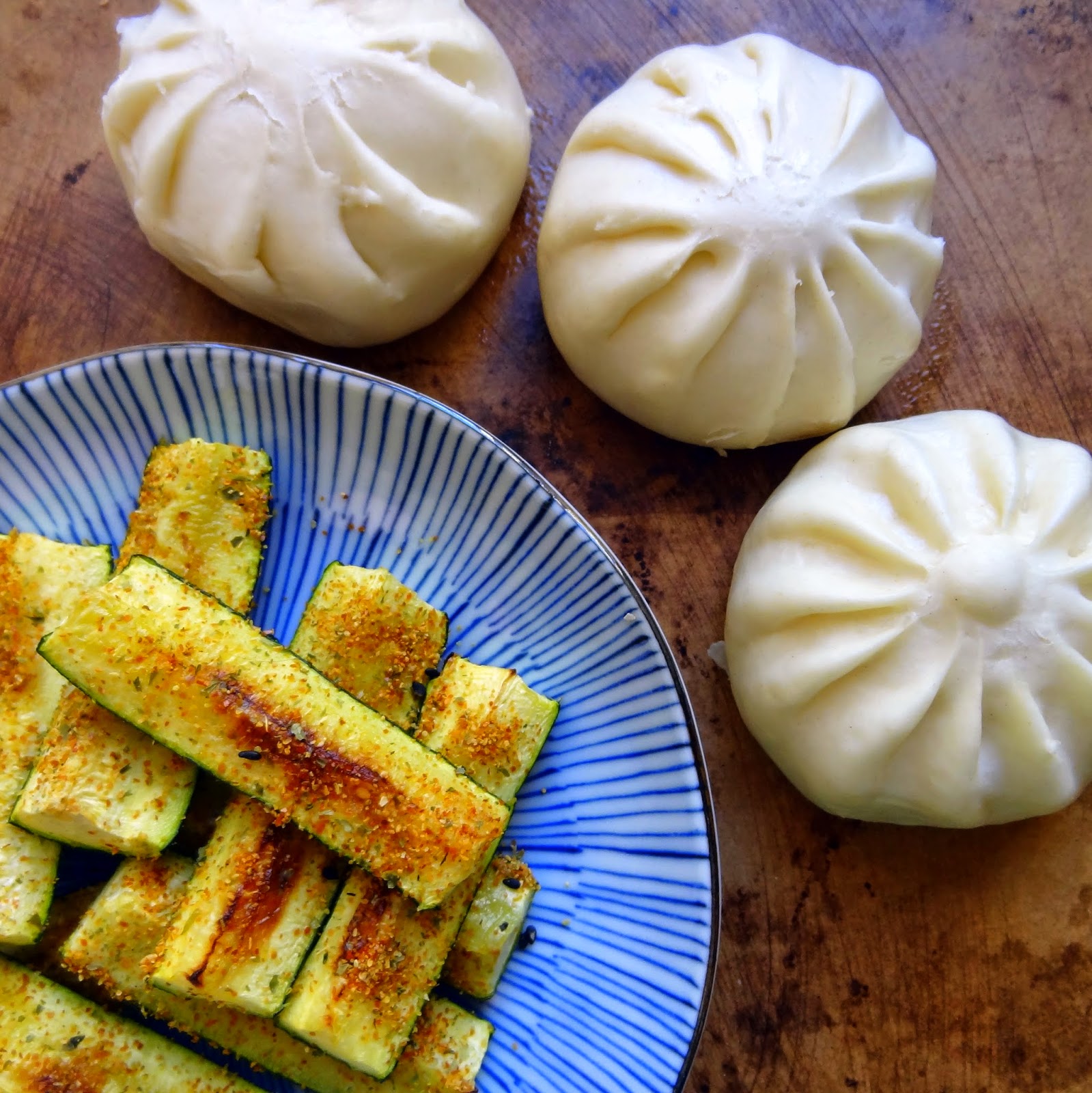
I like creating simple recipes that take little time or effort to make. Sure, sometimes I mix things up with a more-involved recipe, but most of the time my ideas are ludicrously simple.

Like most of you, I'm willing to wager, I've got a Pinterest full of very ambitious ideas I really just don't have time for. But they are inspiring, and I love browsing through and finding these bloggers who invest some serious time into creating amazing things.


This blog isn't one of the ambitious ones. But I'd like to think it's one of the real ones.

I work full-time in a very physically and emotionally draining career. When you've had to wrestle an aggressive 130lbs dog and euthanize someone's childhood friend within 20 minutes of clocking in to your shift, it's hard at the end of the day to want to prepare anything for dinner.

Most workdays, I have to have dinner done in less than 10 minutes (including clean-up) or it just won't happen. Especially when I get off work at 9:30pm and have to be back at 7:30am.

Therefore I rely a lot on easy-to-make entrees, pre-made sides, and fresh veggies that require no preparation in order to get things on the table fast. Here's one of my go-to sides that requires
little-to-no clean up and is healthy to boot!

Friday, March 14, 2014

Tamago-Toji Spam Donburi (卵とじ スパム丼)

Unlike katsudon, this donburi does not have a place in Japanese culinary history, it's an original Miss Mochi creation.

This recipe came about when I happened to score a giant pack of low-sodium Spam from Costco and we only had one frozen pre-made tonkatsu left. Since Mr. Mochi is much more fond of pork chops than I am, I made him a katsudon while I decided what sort of rice bowl I should make. I decided to try a Spam and egg donburi, and it turned out so tasty I decided to share it with you.

A donburi is simply a plain rice bowl with toppings, designed as a complete meal. Here in Southern California, Flame Broiler is probably the most popular chain, as well as of course Yoshinoya, which is an amazingly old fast food chain, founded in 1899. Apparently these quick and tasty meals have stood the test of time, because here in 2014 I am obsessed.

I've made a Spam donburi before, and in that post I rambled a bit about all the variations that could be made. You can make a donburi topping out of anything, and I believe the possibilities are endless. I could probably do a Spam donburi month, and still have plenty of ideas at the end of it.

Hey, that is a pretty good idea! Maybe for May?

Until then, here's the latest iteration of Spam donburi.

Wednesday, December 25, 2013

Katsudon (カツ丼)

Katsudon is definitely a great choice for cold weather. It has a rib-sticking comfort food quality that never fails to satisfy. Filling a bowl with piping hot rice, slipping a crispy crackly fried pork cutlet into a broth bursting with umami and onions, and finally covering everything with a luscious blanket of egg- it only takes minutes if you plan ahead and it is one of the best soul-warming foods, right up there for me with biscuits and gravy.

Now I realize I have very disparate tastes in comfort food, with American Southern cooking competing against Japanese American rice bowls for dominance, but I urge you to give this a try. 

I think the combination of salty fried porky goodness and carbs is universally appealing.

Katsudon is one of the most famous pork dishes in Japan. In fact, if I was being sensible it would have been one of my first blog posts, way before my post on Tonkatsu Karē Donburi. Of course, I don't play by the rules, but really it's a big deal in Japanese casual cuisine. It is even a part of popular culture: in Japanese crime shows, the suspect would be given katsudon to eat in order to make the interrogator seem like a nice fair guy in order to weasel the truth from the suspect.

Another funny anecedote about katsudon is that "katsu" sounds exactly the same as the verb "katsu" (勝つ) which means "to win." This makes this dish popular for sporting teams and students about to take an important test. For example, Hideki Matsui, former World Series MVP for the Yankees, stated in interviews that this was one of his favorite dishes.

Friday, October 25, 2013

Tonkatsu Karē Donburi (トンカツカレー丼)

I seriously cannot believe that I haven't blogged about this recipe before. I've talked about it numerous times, so I have no clue why I haven't shared this recipe with you yet.

Actually, scratch that. I know exactly why I haven't: I hate frying.

I hate frying because I am great at creating epic messes when I cook. My dog hovers outside the kitchen hoping something will drop, and Mr. Mochi usually retreats a safe distance to avoid the Willy Wonka atmosphere I tend to create, complete with weird noises and puffs of smoke and flour.

So when you throw in hot oil and breadcrumbs, I basically destroy my kitchen.

Eggshells in the sink. Flour on my shirt. The dog bursting forth into the kitchen and frantically licking up breading that was flung off into space. Even the bowls for mise-en-place when I'm not frying end up stacked hap-hazardously on all counters like the tea cups of Alice in Wonderland. 

I am a world-class culinary mess maker. A lot of people tend to downplay their faults, strive to make their lives seem perfect from the outside. I can tell you that most food bloggers don't start their posts by telling their readers their faults.

Whatever. I can't pretend that I'm anything more than chaos and entropy, blonde hair and boobs. I don't even know how anyone puts up with me.

Don't fret, I'm sure you will manage to cook this without any of the daikaiju wasteland side-effects. It's actually a really simple recipe with only a handful of ingredients, and shallow frying makes the tonkatsu a breeze to prepare. And if I'm in good company and you're a fellow Godzilla of the kitchen, one bite of this will convince your own Mr. Mochi to help you clean up.

Thursday, September 12, 2013

Karē Tamago Kake Gohan (卵かけご飯のカレー)

I promised you that I would have a curry tamago kake gohan variation this month! I've written many times about how much I love Japanese curry, known as karē, so it only make sense to make a TKG version.

Early this month, I introduced you to tamago kake gohan, which literally means "egg over rice": a very simple dish were a raw egg gets mixed into steaming hot rice for a quick tasty rice bowl. The raw egg cooks a little in the hot rice, for a creamy luscious sauce that coats the grains of rice. It may sound weird, but once you try it, you'll love it too.

As I mentioned last time, since this uses raw eggs, you need to be able to trust your egg source. After all, the heat from the rice does not cook it enough to kill anything creepy. If you don't have parents with heirloom breed chickens in their backyard whose husbandry you trust, there are pasteurized eggs available. However, if the idea of raw egg still makes you queasy even if they are pasteurized, consider how many times you have eaten raw cookie dough without a second thought to the origin of the eggs, or the last time you ordered sunny-side up at your local greasy spoon.

Friday, December 28, 2012

Yoshinoya's Asiana Grill + GIVEAWAY!

I've written about Yoshinoya's donburi before in my donburi recipes, and I'm definitely a fan of their gyudon beef bowls. Recently, however, I got to sample their new fare at the new Asiana Grill.

While their classic beef bowl is still available, along with a chicken pineapple bowl, the Asiana Grill menu is completely different from a regular Yoshinoya. How it works: you pick a meat (or tofu), an entree style, and a sauce. My mother compared it to restaurants like Chipotle, where you pick burrito, taco, or salad and then choose your meat and additions.

So I am sure you are thinking, will this new restaurant style work for Yoshinoya's cheap and healthy Japanese fast food? Let's find out after the jump!

Saturday, September 22, 2012

Gyudon (牛丼)

Gyudon is a relative newcomer to the donburi scene. Because of the era of Nara Buddhist rule, beef was outlawed from being consumed for over a thousand years until the Meiji Restoration. In fact, all four legged creatures were illegal to slaughter for food, partly because of Buddhist beliefs, but also to protect necessary draught animals during famine.

But with the push for more Western ideas, the Meiji Restoration lifted the ban on beef and pork consumption. Even then, beef was a bit of a luxury, due to the lack of land in Japan and the need for the cattle to help with rice cultivation. After rice cultivation was mechanized in the 1950s, cattle were no longer needed and beef consumption picked up along with the price becoming more affordable for the common man.

Still, even today, Americans consume a lot more beef than Japanese. Over in Japan, it's just more expensive, usually needs to be imported, and not as traditional as fish or even pork.

Doesn't mean that they can't cook a mean piece of cow though!

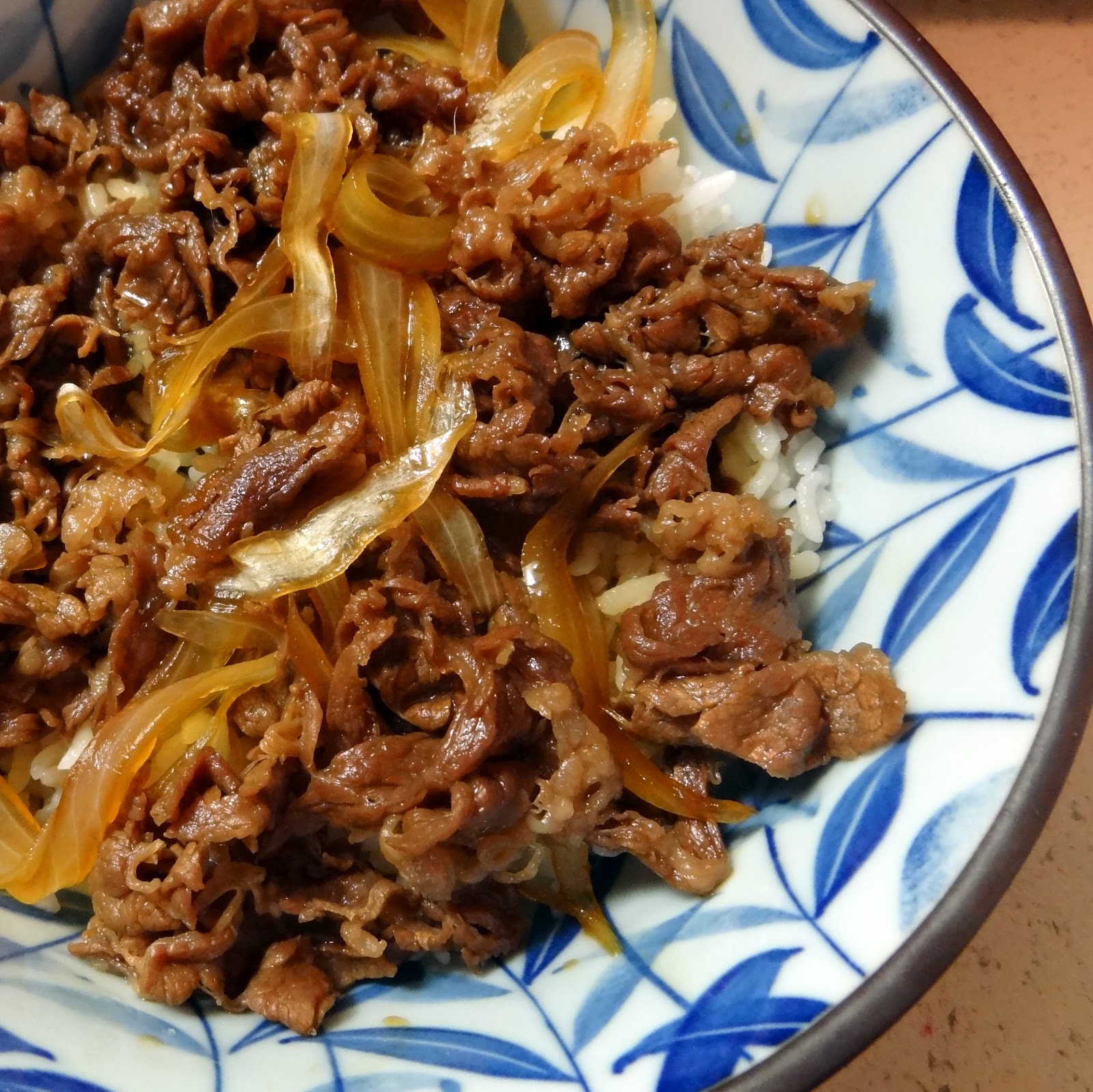
Now that you are all either asleep or bored with history lessons, let's talk a little more about gyudon. Gyudon is traditionally beef and onions cooked in a salty-sweet dashi and soy stock and poured over a bowl of rice. Additions like eggs and shirataki noodles are common, as well as a garnish of pickled ginger called beni shoga. This is Japanese fast food at its best!

Gyudon is one of the best selling donburi in Japan, and in my chikuwa teriyaki donburi recipe where I talk about the donburi in general terms, I mentioned that gyudon is what put donburi establishment Yoshinoya on the map.

Wednesday, August 22, 2012

Lazy Spam Donburi

Today is one of those lazy days when even making some spam musubi is out of the cards. I want to do nothing but lay around on my precious day off and take a nap with Tiara. Even Tiara wants to do nothing but doze off in the air conditioning, and she's a hyper Australian Shepherd! I blame the heat, personally.

So this donburi is kind of a deconstructed spam musubi in a bowl. I have shared my unending donburi love in previous posts, but really, there is nothing easier than a one skillet meal on top of fresh rice.

Lazy Pooch!
The same flavor elements of a spam musubi are present, without having to bother with molding the rice and wrapping it in nori (yes I know it's not a lot of work, but haters please refer to the first word in the name of this post).  You can either use just equal parts sugar and shoyu, but I like the glossiness that mirin lends to the sauce, as well as keeping this whole dish from being too salty.

Like with my spam musubi post, I encourage you to play around with the toppings. Green onions, avocado, okonomiyaki sauce and mayo, shichimi togarashi, sriracha mayo, wasabi mayo, it's all game.

Tuesday, July 3, 2012

Chikuwa Teriyaki Donburi

I cannot deny my donburi love. Donburi isn't a dish, it's a concept. Anything poured or placed over rice in a deep bowl becomes a donburi. Of course, there are classics like una-tama don, egg eel bowl, and katsu karē don, curry cutlet bowl, but I will cook up just about anything, plop it on top of a rice bowl, and serve it.

Donburi have even invaded the United States, and most people have enjoyed donburi without even realizing it. Flame Broiler's beef and chicken bowls are prime examples of delicious fast food donburis.

The star players of easy teriyaki
Yoshinoya, another donburi restaurant here, has been around since 1899! They are most famous for their beef bowl, called gyūdon. Their motto "tasty, low-priced, and quick" embodies what I love most about donburi.

This donburi may not be the most famous, but it is pretty tasty and a good basis to work your own donburi magic. The liquids reduce down to a classic teriyaki, so the chikuwa can be replaced with beef or chicken for a different teriyaki bowl.

Saturday, June 23, 2012

Tsukemono & Furikake Don (丼の振り掛けて漬物)

As you can see, I am working on my Japanese. I am not very good at it, because I rarely have an opportunity to practice. It took me a while to find all the symbols in kanji and hirigana for the title, let alone try and make sure I got it grammatically correct (or close... any Japanese language buffs feel free to correct it).

This dish is what I make when I don't feel like cooking. I guess you could say it is a hapa girl's version of PB&J, but it always surprises me how much I enjoy it.  Tonight, we only had leftovers enough for one person, so Mr. Mochi ate the leftovers and I threw this together for myself.

I have pontificated at great lengths about how much I love shiso katsuo ninniku so it is just as well that I am using it in a dish for this blog. Usually tsukemono like the pink pickled garlic are used as a garnish on or next to the main dish, but here I use them as star players. Also returning to bat is furikake, which I used in an earlier blog post to create the furikake chex mix. This is a much more traditional application of furikake and assuredly just as delicious.

Saturday, June 16, 2012

KFC Katsu Karē Donburi

WARNING! Japanese food purist will hate this post!

As mentioned in my Uomoto curry post, Mr. Mochi's favorite Japanese dish is katsu-karē (カツカレー), where tonkatsu (a deep fried pork cutlet) is served with rice and a generous portion of karē sauce poured over both. He loves to sprinkle shichimi togarashi over it and dig in whenever we go shopping at Mitsuwa. Unfortunately, I don't have a fryer and anyone who has deep fried anything knows that it is messy business trying to do it in a pot.  So when I make it at home, its a rare occasion. I will someday have to make it for this blog, but that will be when I am feeling more ambitious. Having just made some desserts for this blog, namely the Okinawan sweet potato haupia pie and an upcoming treat, I am out of funds and energy.

I needed something cheap, easy, and tasty.

Thursday, June 7, 2012

Uomoto Style Karē

Karē (カレー), or curry, is something that surprises a lot of people about Japanese cuisine. When most people think of curry, they think of India.  But karē, as the Japanese call it, is so ingrained in Japanese society, its considered a national dish. One of Mr. Mochi's favorite dishes when we go to Mitsuwa's food court is katsu-karē (カツカレー), which is a pork cutlet with curry and rice.

Karē came to Japan in the Meiji era (1868-1912) via Britain. Since Britain at the time was occupying India and stealing their spices, the British Navy introduced Japan to curry. That's why Japanese curry is more stew-like and sweeter than most curries as it's an adaptation of Britain's adaptation. Ironically, since it was introduced by the British, karē is considered "yoshoku," a western style dish despite it's eastern roots.

Now of course Japanese Americans have brought it here to America, where we tinker with further like we do all good hapa food. I called the title of my post "Uomoto Style Karē" because this is how my grandmother made it before my mother got a hold of it, and then of course, myself.  The beauty of Japanese curry is that it is traditionally not made with any seasonal ingredients so you can make it at any time.  Those traditional vegetables are potatoes, onions and carrots, but you can experiment with throwing in any sort of veggies you feel like, to give this recipe a seasonal spin.

Monday, May 7, 2012

Una-Tama Don: Egg Eel Donburi

I always tell people if they want to try more adventurous sushi than California rolls, they should try unagi, or freshwater eel. I do this not only because their look of terror is priceless, but because I think it is a very accessible and traditional Japanese meat.  I will explain why I think so, just like I do to the novices to calm them down:

First off, unagi is always cooked. I have no qualms about eating raw fish, but I know this is a big one for beginners. They think all sushi is raw and wriggling.  Second off, it is usually barbequed in a teriyaki style sauce, and served warm. Third, it has a soft and pleasant tenderness to the meat, juicy and never weird or rubbery, unlike tako (octopus).

Thursday, February 23, 2012

Mapo Tofu: The Japanese Version

Mapo Tofu is actually a Chinese dish brought to Japan. This easy-to-make dish consists of ground meat and chunks of tofu enrobed in a spicy oily sauce flavored with fermented chili and soybeans.

Sometimes you will see mapo tofu by different names: mabo tofu or mabo doufu, but it's all the same thing.

Despite its Chinese origins, it is super popular in Japan. The original Chinese-style mapo tofu is blazing hot and complemented by the mouth-numbing effect of the sichuan peppercorns.

The Japanese-style is a bit more laid-back, a bit more umami than face-melting. I love how the nuttiness of the sesame oil takes on a funky fermented kick from the use of miso and fermented chili bean paste.

Picture courtesy of Amazon
This dish has become such a part of Japanese cusine you can even buy the sauce in pouches almost like Hamburger Helper with a helpful slogan "Just add tofu and ground meet!" emblazoned upon it. Even if you buy the "hot" version it is still laughably mild.

If you're craving the spicy Sichuan Mapo Tofu, I recommend checking out these recipes (here and here) by mapo tofu aficionados.