Image Map
Showing posts with label bento. Show all posts

Friday, February 10, 2017

So Cal-Style Taco Rice

Taco rice, also know as takoraisu (タコライス), is a bit of a strange dish. You can trace it back to the 1980s, where outside the American military base in Okinawa, restaurants created their own twist on Tex-Mex. Rather than using a tortilla, rice forms the base of this dish. The easiest way for me to describe it: taco rice is like a taco salad without the giant tortilla bowl. I can imagine cutting out the tortillas made it easier and cheap for the restaurants to make something filling for servicemen.

This dish is so popular in Okinawa, you can even find it at chains like KFC and Yoshinoya periodically as a special item! This is probably the most famous Okinawan food outside of Japan.

I love it because it makes a great dish for bentos and one-dish donburi. It also tickles me how many cultures this food passed through on its journey to invention. Tacos predate the Spanish, a truly indigenous dish of Mexico. The delicious and humble taco then jumped the border to America, who adapted it to the American palate and mass produced it with a hard shell, ground meat, and iceberg lettuce. Then it was brought to Okinawa, where the hard shell was discarded in favor of short grained rice. Mexican-American-Okinawan fusion? Nah, it's just good food, no labels needed.

How do I put my spin on it? By introducing some Southern California style! I couldn't resist adding some fresh guacamole, something you wouldn't see in an Okinawan diner due to the cost of avocados, but here in Orange County, avocados are practically on every dish.

Next, some heat! Taco rice typically is very mild, with no hot sauce at all. I couldn't help tweaking it to fit my palate, and I wanted something that made this dish quintessentially Orange County besides avocados. I grabbed a bottle of Gringo Bandito original hot sauce for the honor. It's made here in Orange County, and was created by the lead singer of the Offspring, Dexter Holland, an Orange County native.

It doesn't get more So Cal-stylish than that! But more than hailing from my home stomping grounds, the Gringo Bandito also brought the dish a nice heat and flavor I needed, without being too salty or vinegary. It's quickly become my go-to sauce for taco night!

My challenge to you: how will you make this dish your own?

Thursday, December 1, 2016

Kamaboko (蒲鉾) and Other Surimi Products

Kamaboko (蒲鉾) is a Japanese ingredient made from white fish that have been pureed, mixed with flavorings, and then steamed to form a steamed fish cake.

Traditionally, kamaboko was formed on a wooden board for steaming which produces the hallmark half-moon shape you see it in.


Nowadays you can find kamaboko without the wood, but most varieties will still be steamed on wood.
Imitation crab sticks work great for cheap sushi

Does this sound totally weird? I wish I could have described it more appetizingly. However, the pureed white fish, called surimi, is the same process that is used to make imitation crab (called kanikama, which is short for kani-kamaboko). So if you've enjoyed a california roll, you've had surimi. The biggest difference between imitation crab and kamaboko is just the texture as kamaboko is chewier and firmer.

Tuesday, November 22, 2016

Julia's Korroke

All I wanted for my birthday was to learn how to make Julia's amazing korokke. Julia is one of my mother's very best friends and someone I consider to be part of my family. They've known each other since before I was born, and I grew up going over to their house, going on road trips together, and spending holidays with them.

I learned to ride horses with Julia's instruction, while her husband introduced my brother and I to the awesome world of computer games. I was too young to notice it at the time, but they were very influential in my life, encouraging me in my academics but also my hobbies as well. I'm thankful every Thanksgiving I've had so many amazing role models in my life. I know that sounds super cheesy, but you haven't met them! Our families go camping together, horse trail riding together, and even thrift shopping with one another! I especially like playing board games at their house, and wish my work hours didn't prevent me from seeing them as often as I'd like.

Julia's son got me set on this idea when he mentioned that his favorite part of Thanksgiving was his mom's croquettes, which is served with the traditional okonomi sauce (sosu), but also ranch dip. It just wasn't Thanksgiving without it, in his opinion.

Ranch dip? On korokke? I had to see this. And then Julia brought some over to my parent's house, and I was hooked. I would have never in a million years thought that ranch would work with croquettes, but it is delicious. I personally liked to alternate between the okonomi sauce and the ranch dip, so each bite sings.

Korokke, or Japanese croquettes, are very similar to the French croquettes, but are usually made with a higher ratio of potatoes to meat and served with the same family of tangy sauces that tonkatsu and a lot of fried foods is served with.

Sunday, October 2, 2016

Ekiben and Japanese Train Stations

Southern California does not have the best public transportation, especially where I live in the suburbs of Orange County. When I lived with my parents, we didn't even have street lights or sidewalks, let alone a train or subway system.

Japan, on the other hand, has amazing public transportation. I can see why so many Japanese don't have cars. It's like New York City, it's almost a bother to have a car. The shinkasen, or bullet train, was possibly the coolest form of transportation I've taken in quite a while. The only train that I had ever taken prior to this trip to Japan was the train at Disneyland (no, stop laughing, I'm not joking).

The shinkasen reached top speeds of 200mph but was so smooth and quiet I fell asleep on it quite a few times. I was worried about getting motion sickness as I'm prone to it in cars and I was still a bit jet-lagged when I stepped on my first shinkasen to head to Hiroshima, but it was so butter smooth I was able to read without any headache.

We were all very excited to try ekiben (駅弁) as well. We had heard of the delicious train bentos sold at the train stations that showcased local cuisine, and I made sure to take tons of pictures.

I apparently missed the golden age of ekiben, which occurred in the 1980s. Back then, the trains were slower and plane rides were so expensive, a lot of people traveled by train. And since the trains were slower, more people relied on ekiben as a meal while traveling. Now, with the shinkasen reaching top speeds of 150-200mph, you might not get to finish that meal! Despite this, ekiben are still a thriving aspect of most train stations in Japan and I made a point to snap some pictures to share with you.

Monday, July 25, 2016

Mizuna, Apple and Jicama Salad with Yuzu Kosho Vinaigrette

I don't post a lot of salad recipes. They generally aren't my favorite thing, especially when the lettuce leaves are huge and they end up slapping me in the chin and I get salad dressing everywhere and look like an idiot. I never claimed to be graceful, in fact I'm pretty much a walking disaster when it comes to food and a lot of other things now that I ponder it.

I've written about the chaos that ensues while making dishes, but I'm also a natural disaster whilst dining as well. Spaghetti and salads made with lettuce are a sure-fire way to ruin a blouse in my book. I rarely disappoint when it comes to this splattering, despite being a slow and careful eater. This trait seems to be genetic, as my father tends to involuntarily decorate his button-downs as well.

However, here's a salad that I'd be willing to wear white silk around because mizuna isn't nearly as ungainly on a fork as romaine or butter lettuce, especially when you chop it down to size. I mean, don't get me wrong, if anyone can make a mess of things it's me, but I'd at least take that challenge. My only other beef about salads: their names are often unwieldy as hell!

Wednesday, July 20, 2016

Mentaiko

Mentaiko, especially spicy karashi mentaiko, is a specialty of the Hakata ward in Fukuoka City. Mentaiko is fish roe (normally pollock) that is marinated in chili, sake, konbu and yuzu citrus, and then slightly fermented for several hours.

Karashi mentaiko is so popular that usually the term "mentaiko" refers to the type that is spicy, while "tarako" is the regular marinated roe.

Mentaiko is actually originally Korean, as is a lot of the ingredients and dishes that Kyushu is famous for as they are very close to Korea there in the southern regions of Japan.

Mentaiko can be seen traditionally served by itself as a side dish to sake.  It can be eaten raw or cooked (it turns a lighter pink when cooked) and either in its egg sac or removed.

This is how the eggs look removed from the egg sac membrane
One of the more traditional ways you will see it served is over rice with the egg sac intact, where it is often cooked with a bit of oil first. Another traditional use is as a filling for onigiri rice balls or topping sushi, however these days this flavor powerhouse isn't limited to just rice.

You'll find mentaiko incorporated with cream as a delicious pasta sauce, used as way to spice up egg omelettes, baked on top of french bread, mixed into potato salad, spread on top of skewers of chicken, and even as a topping for Japanese pizza! One crazy concoction I love is mochi baked with cheese and mentaiko for a gooey chewy savory-spicy mess.

Here in the states, you can find mentaiko at Japanese grocery stores like Mitsuwa and Marukai. It freezes fairly well, which is good because it's not cheap!

Recipes that use mentaiko:
Fries with Mentaiko Mayo Dipping Sauce

Saturday, June 28, 2014

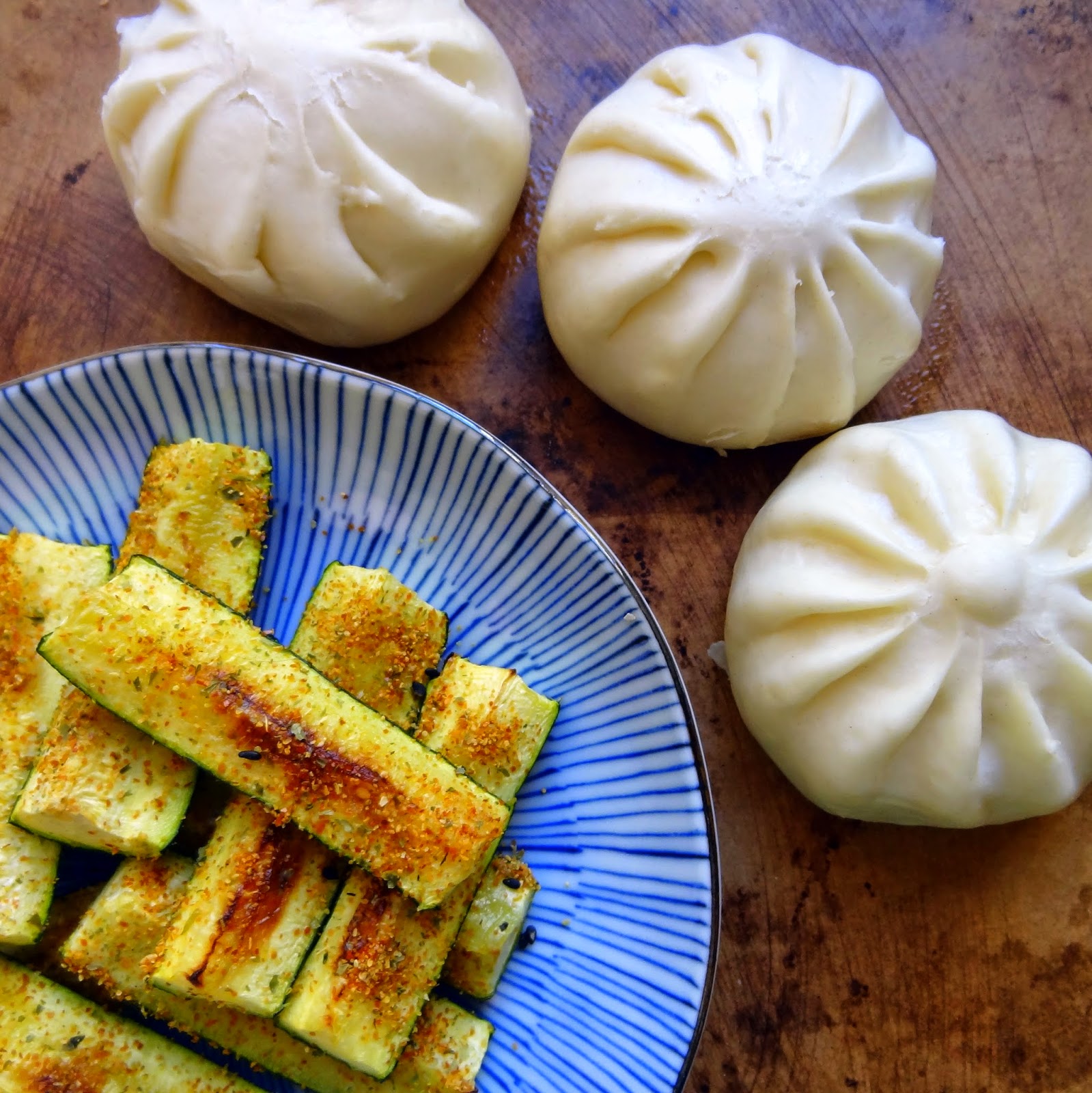
Togarashi Zucchini

I like creating simple recipes that take little time or effort to make. Sure, sometimes I mix things up with a more-involved recipe, but most of the time my ideas are ludicrously simple.

Like most of you, I'm willing to wager, I've got a Pinterest full of very ambitious ideas I really just don't have time for. But they are inspiring, and I love browsing through and finding these bloggers who invest some serious time into creating amazing things.


This blog isn't one of the ambitious ones. But I'd like to think it's one of the real ones.

I work full-time in a very physically and emotionally draining career. When you've had to wrestle an aggressive 130lbs dog and euthanize someone's childhood friend within 20 minutes of clocking in to your shift, it's hard at the end of the day to want to prepare anything for dinner.

Most workdays, I have to have dinner done in less than 10 minutes (including clean-up) or it just won't happen. Especially when I get off work at 9:30pm and have to be back at 7:30am.

Therefore I rely a lot on easy-to-make entrees, pre-made sides, and fresh veggies that require no preparation in order to get things on the table fast. Here's one of my go-to sides that requires
little-to-no clean up and is healthy to boot!

Friday, March 14, 2014

Tamago-Toji Spam Donburi (卵とじ スパム丼)

Unlike katsudon, this donburi does not have a place in Japanese culinary history, it's an original Miss Mochi creation.

This recipe came about when I happened to score a giant pack of low-sodium Spam from Costco and we only had one frozen pre-made tonkatsu left. Since Mr. Mochi is much more fond of pork chops than I am, I made him a katsudon while I decided what sort of rice bowl I should make. I decided to try a Spam and egg donburi, and it turned out so tasty I decided to share it with you.

A donburi is simply a plain rice bowl with toppings, designed as a complete meal. Here in Southern California, Flame Broiler is probably the most popular chain, as well as of course Yoshinoya, which is an amazingly old fast food chain, founded in 1899. Apparently these quick and tasty meals have stood the test of time, because here in 2014 I am obsessed.

I've made a Spam donburi before, and in that post I rambled a bit about all the variations that could be made. You can make a donburi topping out of anything, and I believe the possibilities are endless. I could probably do a Spam donburi month, and still have plenty of ideas at the end of it.

Hey, that is a pretty good idea! Maybe for May?

Until then, here's the latest iteration of Spam donburi.

Saturday, February 8, 2014

Fruit Sando (フルーツサンド)

Today is the second anniversary of my very first blog post here at Miss Mochi's Adventures. I'm still wrapping my head around that fact. Do me a favor and don't look back too far, some of the pictures definitely need updating! I'm still not very confident in my photography skills, but anyone can see I've made a big improvement.

The very first recipe I posted for this blog was ichigo daifuku mochi, so in celebration I decided to post another recipe involving strawberries. This one garnered a lot of interest when I mentioned it in my katsu sando post, after all, who here in the states has heard of a fruit and cream-filled sandwich?

The Japanese definitely treat bread and sandwiches differently than we do. They don't balk at strange sweet sandwich fillings, because they don't have a long standing history of savory sandwiches like we do. Fruit and cream sandwiches as well as other sweet sandwiches like chestnut cream are on the convenience store shelf right along with ham and cheese. And if you think about it, we certainly have sweet sandwiches that are immensely popular: PB+J anyone? Peanut butter and jelly sandwiches are so ubiquitous that they have an acronym in popular use! No one would think twice if you made a peanut butter and banana sandwich, or a peanut butter sandwich with some strawberry slices thrown in.

Wednesday, January 15, 2014

Katsu Sando (カツサンド)

I know that Japanese cuisine is famous for it's use of unadulterated white rice. Donburi, onigiri, curry rice all use plain white rice. At nearly every meal, white rice is a star player.

However, the Japanese do eat bread, especially in modern times. They even make sandwiches very similar to ours, albeit with some Japanese flair, called "sando" (サンド). Some popular fillings include egg salad or ham, but you may be surprised to see even varieties like fruit sandwiches.


Marukai's Katsu Sando
The best bread for making a sando is shokupan (食パン), which is a soft pillowy bread that is slightly sweet, and manages to be soft while still having a very tight grain that has some stretch and spring to it. Honestly it's kinda like the mochi version of sandwich slices, soft but stretchy. I also like it because it's perfectly square, and you can get it cut thick. I used it in my Milk Toast post; I like it in this recipe because it doesn't compress down into nothingness like regular sliced bread here in America will, but if you don't have access to shokupan and don't feel like baking, I have some alternatives and suggestions for you down below.

Here's a hearty sando using tonkatsu, one which is a snap to make if you make a whole bunch of tonkatsu at once and freeze the extras. This is also good for those of you who don't have a rice cooker, or you too have your own version of Mr. Mochi breathing down your neck while you edit a blog post. (Hence the less than stellar photography, and I actually only had some pretty wimpy cheap white bread around.)

Tuesday, March 5, 2013

Sake Ochazuke (鮭 お茶漬け)

Sometimes you just want to stay in and curl up with a good book and something tasty, preferably a hot comfort food.

Ochazuke (お茶漬け), or chazuke, is really quite simple; it is green tea poured over rice, like milk over cereal. What really brings this dish to life is the toppings that go along with it. Umeboshi (pickled plums), shiozake (salted salmon), wasabi, kakimochi (rice crackers), nori, and fresh herbs like mitsuba are all usual suspects. Some variants of ochazuke use dashi or plain water, but I like the flavor green tea adds.

There are commercial packets you can buy, and then all you need is rice and hot water. These are very convenient for a packed lunch for work, I can run out the door with a bowl of leftover rice and all I need is some hot water to make a nice lunch at work of hot ochazuke.

However, I have a recipe here for when you want a homemade ochazuke, and I think you will enjoy the hearty amount of salmon and the ability to salt to your taste since the commercial packets can be quite salty.

Wednesday, December 12, 2012

Miso Tamago

The trifecta of my favorite bento hard boiled eggs concludes with this post: Miso Tamago.  Miso marinated hard boiled eggs are like marbled tea eggs and shoyu tamago in that they are portable and seasoned well enough they can be eaten by themselves, unadorned. Not that they aren't delicious mixed into a salad, but I like being able to tuck them into a bento with some rice and tsukemono, furikake and veggies for a quick and light lunch.

Also delicious as a ramen add-on, slice one in half and dunk it in the ramen, miso and all.

Unlike the shoyu tamago which don't store well in the fridge, the miso tamago and marbled tea eggs are fine to sit in the fridge for a couple days. In fact, you want the miso tamago to sit in the fridge at least for a couple hours or overnight, to make sure the miso permeates the egg.

The miso you use will directly affect the taste of the finished product, so it is best to use a good quality fresh white miso. Red miso would probably end up making the egg too salty, but feel free to experiment.

Tuesday, November 13, 2012

Kaki Kohaku Namasu (柿 紅白なます)

Kohaku Namasu (紅白なます) is a traditional celebration food in Japanese culture, most prominent around the New Years festivities. Usually it is made with julienned carrots and daikon radish that is soaked in a rice vinegar mixture. Red and white (kohaku) are considered lucky colors together, and even though this dish is actually orange and white, it's close enough.

And while New Year's is still a couple months away, I can't help but get wrapped up in the excitement before Thanksgiving. This is both a party dish and a quintessential fall dish, thanks to the persimmon, so I could see it at our table this Thanksgiving.

I decided to make this version because I still have quite the haul of fuyu kaki leftover despite my bundt cake. The persimmon takes place of the carrot, and substitutes well since both have a nice sweetness that plays off the bitter daikon and salty vinegar dressing. Some recipes include citrus juice, to play up the acidity.

Some people like to serve kohaku namasu immediately, other suggest letting it settle in the fridge for several hours or overnight to let the daikon and vinegar mellow.

Took forever, still huge pieces!
Every recipe also varies on the ratio of white to orange, so feel free to have more or less than I suggest based on your fancy. I kept eating the fresh persimmon and the freshly salted daikon before they ever made it into the vinegar mix!

When making this, I realized I am terrible at cutting things. Julienning the daikon and persimmon took forever, and I wasted a lot of the persimmon just because I didn't know how to properly make a squat round shape into matchsticks. Even then, the julienne pieces ended up being like 1/4" big. Oh well, maybe it's time to invest in a mandoline.

Thursday, November 8, 2012

Japanese Curry Turnovers

When talking about my blog, my mother wanted to know if my blog followers were aware I was "The white girl version of a Japanese person," and I assured her that anyone who clicks on the About page would know I am very Caucasian in appearance, jokingly telling her, "Don't worry, they know I'm Jet Puffed Japanese!"

I think she was worried people would be deluded into thinking I'm some sort of wannabe Harumi Kurihara of the States. (Harumi Kurihara is like the Japanese Martha Stewart, and her cookbooks are awesome by the way). Just because I resemble my nickname (white, squishy, and sweet describes both me and mochi) doesn't mean I don't love sharing my hapa Japanese dishes with you all.

Even in high school, kids would look at me and tell me I don't look Asian enough to call myself part Japanese. Funnily enough, with his dark hair and more olive complexion, my brother would pass their test.

The best thing about being white-as-a-marshmallow yet also Japanese American, is that I am free to mix my cultures as you see fit. Especially since my mother and grandmother were bit of rebels when it comes to cooking, we all blur the lines a lot. Tuna sandwich with a side of ramen? Check. Tsukemono and deviled eggs at Thanksgiving? Every year!

So when I decided to bust out the puff pastry dough to make some meat pies (I love pasties) and instead ended up with a Japanese American version, I don't think either of those cooks would be surprised.

Saturday, September 22, 2012

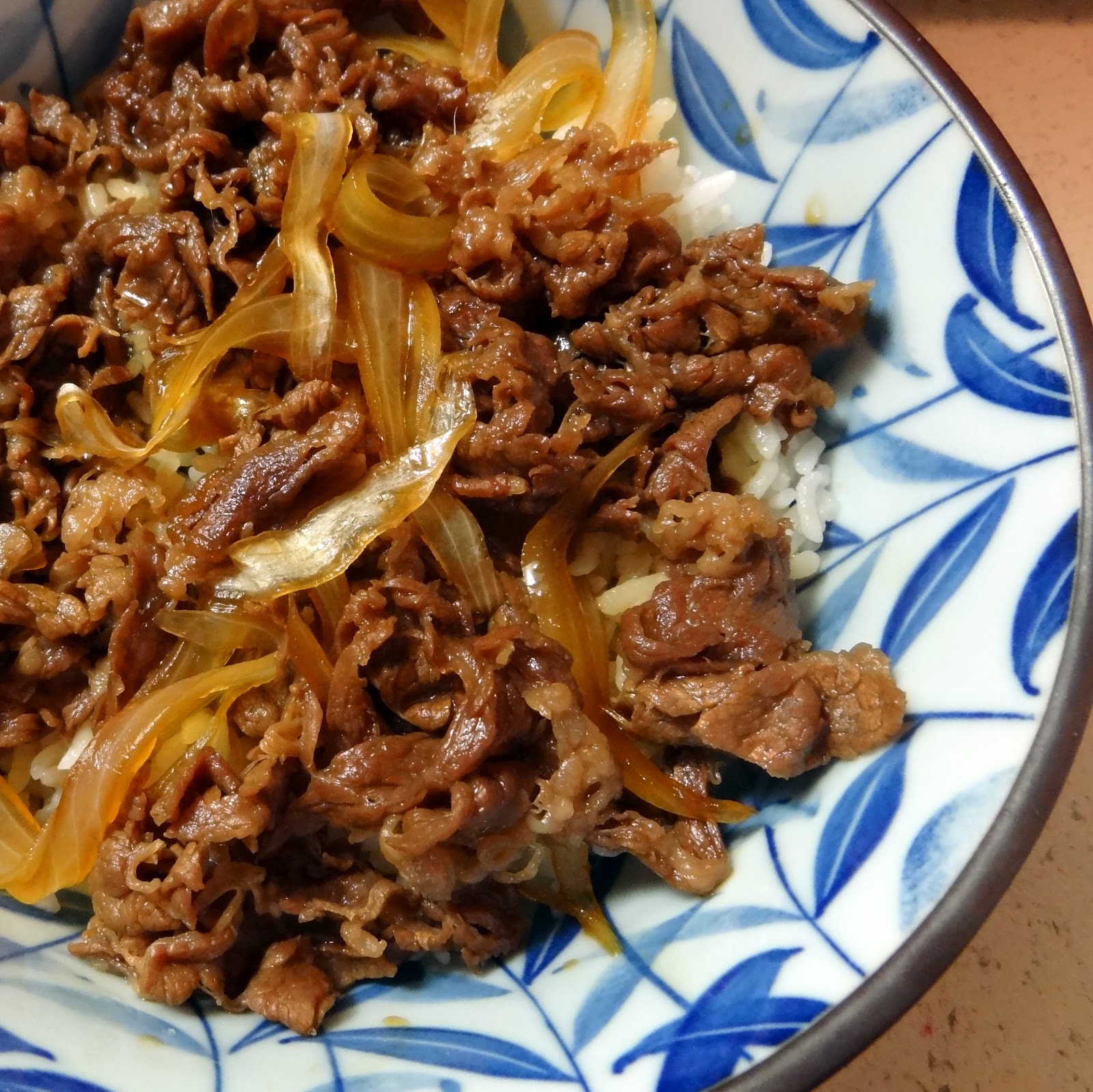
Gyudon (牛丼)

Gyudon is a relative newcomer to the donburi scene. Because of the era of Nara Buddhist rule, beef was outlawed from being consumed for over a thousand years until the Meiji Restoration. In fact, all four legged creatures were illegal to slaughter for food, partly because of Buddhist beliefs, but also to protect necessary draught animals during famine.

But with the push for more Western ideas, the Meiji Restoration lifted the ban on beef and pork consumption. Even then, beef was a bit of a luxury, due to the lack of land in Japan and the need for the cattle to help with rice cultivation. After rice cultivation was mechanized in the 1950s, cattle were no longer needed and beef consumption picked up along with the price becoming more affordable for the common man.

Still, even today, Americans consume a lot more beef than Japanese. Over in Japan, it's just more expensive, usually needs to be imported, and not as traditional as fish or even pork.

Doesn't mean that they can't cook a mean piece of cow though!

Now that you are all either asleep or bored with history lessons, let's talk a little more about gyudon. Gyudon is traditionally beef and onions cooked in a salty-sweet dashi and soy stock and poured over a bowl of rice. Additions like eggs and shirataki noodles are common, as well as a garnish of pickled ginger called beni shoga. This is Japanese fast food at its best!

Gyudon is one of the best selling donburi in Japan, and in my chikuwa teriyaki donburi recipe where I talk about the donburi in general terms, I mentioned that gyudon is what put donburi establishment Yoshinoya on the map.

Friday, August 10, 2012

Shoyu Tamago (醤油 卵)

Shoyu Tamago (醤油 卵) means soy sauce egg in Japanese, which is a pretty self explanatory name: hard boiled eggs cooked in soy sauce until the outside is wonderfully salty and umami-filled, with a beautiful mahogany color.

The best thing about shoyu tamago is that these eggs wonderfully portable and great for picnics. Unlike plain hard boiled eggs, there is no need to bring along salt and pepper because these are preseasoned.  A spam musubi and a shoyo tamago, along with some celery and carrot sticks, make an amazing packed lunch.

Since I always have access to insane amounts of eggs (see my Hapa Farm Girl post on eggs) I tend to try and use eggs a lot. Especially since nutritionists have found that eggs are no longer a cholesterol scare which was touted back in the day, and they have found the healthier the chickens eat, the better the eggs are for you.

There's only one snag: Mr. Mochi hates hard boiled eggs, even deviled eggs!

Friday, August 3, 2012

Hapa Farm Girl: Nasu Dengaku (茄子田楽)

Time for another edition of Hapa Farm Girl! The nice thing about summer is the fresh veggies! My mom gave me a care package this week: 18 eggs, a bunch of shiso leaves, cherry tomatoes, and a couple Japanese eggplants.  I toyed with the idea of making a mini caprese salad with the tomatoes, some bocconcini and shiso since I don't have basil, but I ended up just eating the tomatoes on the spot from the bag. I love cherry tomatoes!

So onto the eggplant.  I have never liked the name eggplant, considering the varieties that look like eggs rarely pop up anymore.  Also know as aubergines, or in Japanese, nasu (茄子). Some funny facts about the eggplant: it is part of the nightshade family like tomatoes and potatoes, is related to the tobacco plant, and has more nicotine than any other edible plant. Still, you would have to eat 20lbs of eggplants to equal one cigarette. Wikipedia is a crazy place.
 
Japanese eggplants are generally very dark thin-skinned, almost black, and long and skinny.  There are round Japanese varieties but they still have the hallmark thin skin, so most Japanese eggplant dishes do not peel them. I decided to make some traditional izakaya (pub) food, nasu dengaku (茄子田楽).  For this recipe, the eggplants are split in half, grilled and then slathered with a sweet miso sauce that gets caramalized for a smooth sweet/salty/smokey snack that is delicious on its own or with rice.

Sunday, July 29, 2012

Bacon Corn Chowder

This recipe has no exotic Japanese American ingredients. It's all American. As I've said in my Southern biscuits and gravy post, I am heavily influenced by the way the women who raised me cooked, which was my Japanese American grandmother and mother. However, I do switch it up and cook Southern, New Mexican, and American Indian once in a while.

While traditional American Indian food is for another post, it is funny to think about the American Indian influences on modern cuisine today.  Already pish-poshing?  How you liking your popcorn at the movies?  Corn cultivation and domestication is all thanks to the indigenous people of the Americas. We tend to forget when we sit down to beans, sweet potatoes, cranberry, and turkey every year, but American Indian influences go beyond Thanksgiving.

And let's not forget the potato, which may seem like an old European staple, was brought back from the Americas by the Spanish.

In fact, according to What's Cooking America, the first chowders in America were eaten by American Indians. However, you cannot necessarily say that they introduced Europeans to chowder, because chowders are in every culture.

Bacon and pigs, however, was introduced to the Americas, and made it a better place. hehe!

Tuesday, July 17, 2012

Marbled Tea Eggs (Cha Ye Dan)

Tea eggs are perhaps the prettiest eggs you are ever going to see besides those painted for Easter, and tea eggs taste better.

Usually found as a street food in China, tea eggs are cracked hard boiled eggs that are heated in a mixture of spices, tea, and soy sauce for a period of time until the egg white gets infused with flavor. The pretty marbled pattern is the by-product of the shell being left on and the flavoring seeping through the cracks. You can completely peel the eggs and therefore bypass some of the steeping time, but I love the look of the marbled eggs.

The best thing about this recipe is you can let them steep as long as you like. The Chinese American bakery near my school has a crockpot of these simmering nonstop, and nothing is tastier than walking to class munching on one. The longer you simmer, the more deeply the flavor will penetrate. I know cooks that will let the eggs steep overnight in the cooking liquid, and who knows how long they simmer in that crockpot at the bakery to achieve such deliciousness!

I like these tucked into a bento, or chopped and mixed with a bit of mayo for an interesting egg salad. Try them warm and cold, I like both.

Tuesday, July 3, 2012

Chikuwa Teriyaki Donburi

I cannot deny my donburi love. Donburi isn't a dish, it's a concept. Anything poured or placed over rice in a deep bowl becomes a donburi. Of course, there are classics like una-tama don, egg eel bowl, and katsu karē don, curry cutlet bowl, but I will cook up just about anything, plop it on top of a rice bowl, and serve it.

Donburi have even invaded the United States, and most people have enjoyed donburi without even realizing it. Flame Broiler's beef and chicken bowls are prime examples of delicious fast food donburis.

The star players of easy teriyaki
Yoshinoya, another donburi restaurant here, has been around since 1899! They are most famous for their beef bowl, called gyūdon. Their motto "tasty, low-priced, and quick" embodies what I love most about donburi.

This donburi may not be the most famous, but it is pretty tasty and a good basis to work your own donburi magic. The liquids reduce down to a classic teriyaki, so the chikuwa can be replaced with beef or chicken for a different teriyaki bowl.