Image Map
Showing posts with label tea. Show all posts

Monday, September 12, 2016

Adventures in Japan: Beppu and Yufuin!

Beppu and Yufuin are both resort towns in the Oita prefecture in Kyushu. We stopped at both along our way back from Yawatahama back to Fukuoka.

Beppu and Yufuin are both famous for their onsens, but the Eight Hells of Beppu (別府の地獄), where you can see plumes of steam rising was quite the impressive sight! Even when driving around we could see plumes of steam rising around the city. It was very eerie as it looked like the whole place was about to go up in a volcano.

Check out the steam plumes!
After leaving Yawatahama (I fell asleep on the ferry back, it was a very long day), we arrived in Beppu to spend the night at the Umine hotel in Beppu. Our relatives wanted us to try the onsen hot springs that Beppu is famous for, but worried that we would balk about getting naked in a public onsen. So instead, this hotel had a private onsen bath with an ocean view in our hotel room! The hot spring water is piped into an outdoor patio for private enjoyment without having to even leave your room.

Sunday, September 11, 2016

Tenjosajiki Cafe (天井桟敷)

After leaving Beppu, we drove up and down mountains to reach Yufuin. We stopped by Yufuin on our way back to Yawatahama for a quick visit so our relatives could show us more of Kyushu.

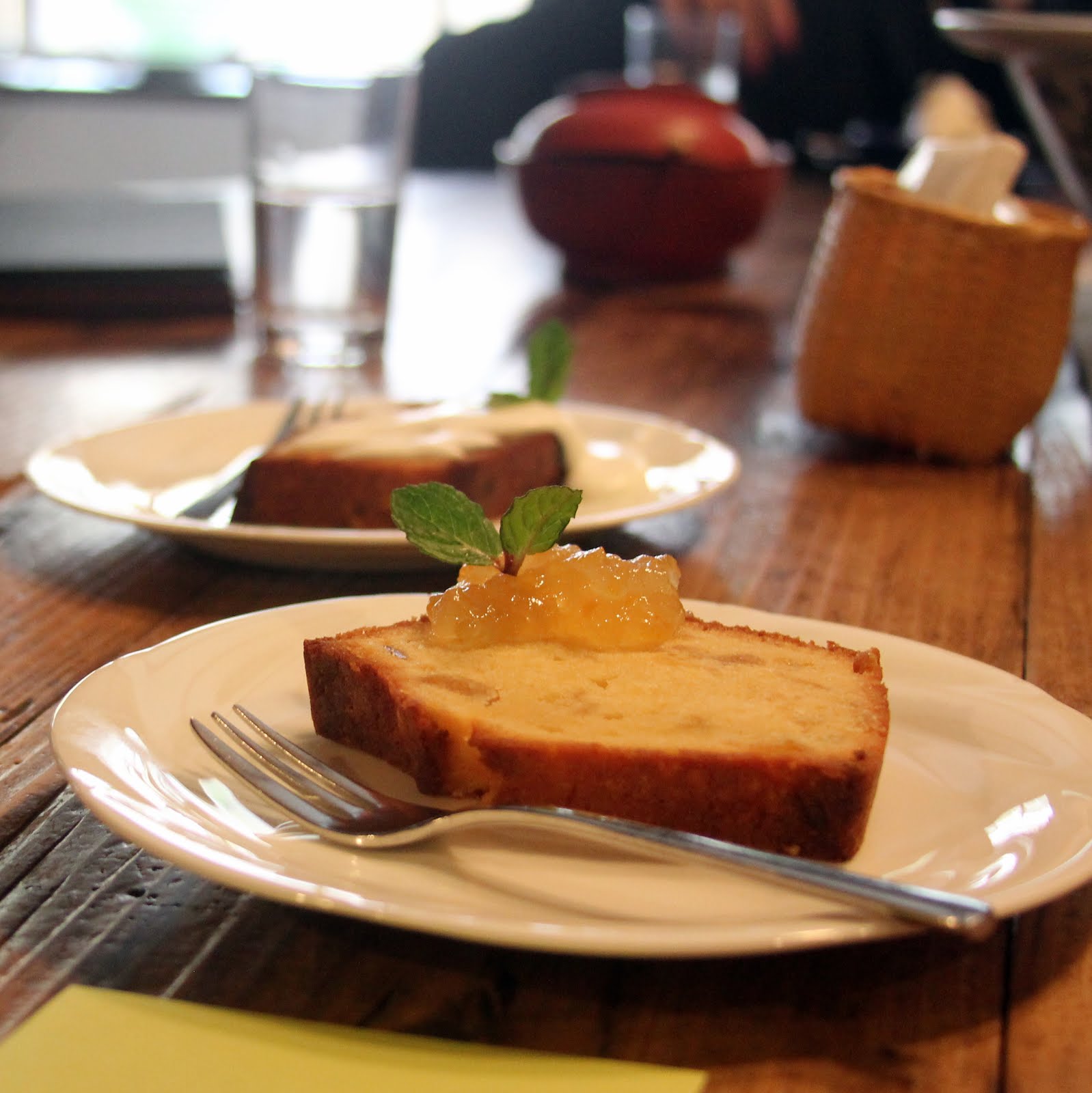
While in Yufuin, we stopped by Kamenoi Bessou (亀の井別荘) a ryokan (inn) that included hot springs, a wonderful souvenir shop, and a restaurant space upstairs that was a cafe during the day and a bar after 7pm, called Tenjosajiki Cafe and transforming into Yamaneko (山猫) at night.

The ume pound cake
We picked up some citrus jam from the ryokan shop and ate it with toast all throughout our trip. It was less like a kitschy American souvenir shop and more like a luxury specialty shop that focused exclusively on regional and seasonal items. I loved browsing through there!

And stepping outside to take in the greenery surrounding this ryokan was magical: the mists swirled around lush greenery, cherry blossoms, and leafy trees. For a Southern California resident used to nothing but drought, it was truly like being transported to a magical forest.

Tuesday, August 9, 2016

Kansansoubekkan (観山荘別館)

Our most memorable meal of Fukuoka (and perhaps the enitre trip) was at Kansansoubekkan (観山荘別館), a kaiseki restaurant.

Let us be clear: I am not a kaiseki person and neither is my mother. I'm a fan of donburi, ramen, and mochi. I am solidly a B-class gourmand. My mother is the type of person that got bored in France because every meal took so long.

So kaiseki was a leap for us. For those uninitiated in what kaiseki is: Kaiseki is a multi-course meal that really takes food to an art form.

Only seasonal ingredients, cooked fresh, are used, prepared and plated in a way to highlight not only the taste but the visual appeal of the dish.

We were served 12 different dishes over several hours in a gargantuan private room with just us in it and a view of their beautiful garden. It was a crazy ride, and something I am so glad I was able to experience!

We were sat in a traditional style room, without chairs, but there were several larger parties that elected to sit in a more western banquet style. We took a tour of the garden and took pictures in it, which I don't think most people were allowed to do, because we certainly messed up the pretty gravel designs by walking on it.

Wednesday, October 8, 2014

626 Night Market 2014

I cannot wait for this weekend's OC Night Market, so I decided to celebrate by sharing my adventures from last month's 626 Night Market. I went last year and blogged about it, but this year was even more fun!

My mother decided to join me for a night, and I really enjoyed it. It's always nice to go to an event like this with someone new, because they will invariably try something completely different than you would normally. My mother especially is adventurous, and there's the added bonus of her being a much better photographer than me, especially for crowd shots.

I also went with the same buddy from the DTLA Night Market post, as well as Mr. Mochi on a different day. I have way too much fun at these events, sometimes when I'm full I just like sitting there and people-watching. Nearly everyone is having a blast, and watching people get excited over a special food is fun to watch.

Tuesday, December 10, 2013

Chai Persimmon Sorbert

My great uncle grows the crisp variety of persimmons ("kaki" 柿), called fuyu. Every year, I am entrusted with a giant Trader Joe's bag full of the beautiful orange fruit. I should have weighed the bag to find out exactly how many pounds, but trust me when I say it's way too many for one Miss Mochi to eat.

I stuffed them into bundt cakes for Thanksgiving. I chopped them over Greek yogurt and granola, sprinkled with cinnamon for breakfast. I served them as an appetizer with brie and crackers. I made bowls and bowls of fruit salad.

They were still ripening too fast for me to consume or cook them all fresh. I had some so ripe they were jiggly custard bombs ready to explode. I needed to do something, stat.
Betty has a new attachment!

And then I found this recipe, and swooned immediately. I knew exactly what I would do to salvage all the overripe persimmons crowding my counters. I knew this was what I was looking for, and I couldn't wait to play up the natural spiciness of the persimmon with strong chai tea rather than plain black tea. I also couldn't resist using a gift card to get myself an ice cream maker for my tangerine-colored mixer, "Betty."

This recipe can be made with either the hachiya, which is astringent until it is ripened to jelly-level, or the fuyu, which normally you would eat when it is as firm as a pear or apple, but the fuyu is perfect for this if you let them ripen past that.

Tuesday, October 22, 2013

Matcha Shortbread Cookies

I was a weird little kid. I loved all sorts of sour or bitter things, like kumquats and coffee. I definitely still loved sweet things, but even then my favorite candies would be the sour ones like warheads or sour patch kids. The waitresses used to think I was very strange to order coffee (decaf of course) and drink it just like my dad with cream and sugar.

This is all funny, because I didn't immediately love green tea, which has definitely eclipsed coffee in my book. It wasn't until I was probably around ten years old that I really appreciated green tea.

I love the popped rice in genmaicha!
I love pretty much all green tea, from toasty-roasty hojicha to mellow and sweet genmaicha. I love a hot cup of tea with a rowdy group of friends at Honda-ya, and I also love it curled up with a good book on a night in.

Of course, I also love to cook with it.

Most recipes you see that say "green tea this-or-that" are made with matcha. Matcha is made by taking the finest tea leaves that are grown in the shade and then drying and grinding them into a powder. It is much sweeter than normal green tea, and is a beautiful vibrant shade of green. Traditionally it is used primarily for tea ceremony, but nowadays I happen to think more people make sweets and baked good with it than actually drinking it with hot water.

This recipe is no exception, I borrow the sweet and bitter taste of matcha along with its gorgeous color. I also use genmaicha as a decorative garnish, and the roasted grains of rice add a pleasant crunch.

Tuesday, September 17, 2013

Yuen Yeung Popsicles

I wasn't kidding when I told you I was obsessed with popsicles recently! I've been trying to create fun flavors that I can't buy in the supermarket. My latest brainwave was taking the drink Yuen Yeung and turning it into a dessert!

Yuen yeung, also known as yuanyang, yinyong, or yinyeung, is a super tasty and easy to make drink. Yuen yeung, named after the opposites-attract nature of Mandarin ducks, is milk tea and coffee mixed together, and can be served either hot or cold. This drink hails from Hong Kong, where it was originally served with street food, then it graduated to being served in tea cafes. In fact, this drink has become so popular that Starbucks in Hong Kong had a Yuen Yeung Frappuccino!
I so want to try one!

Since the coffee/tea hybrid is usually made with Hong Kong-style milk tea, it can be very rich because it is made with evaporated or condensed milk. I usually prefer frothier and lighter bubble milk tea when served chilled because that uses milk instead, but I knew that Hong Kong-style milk tea was totally the way to go in this case because it would make the end result totally creamy like a fudgesicle!

Of course, I couldn't resist throwing in a twist and adding in some spice just for a little stronger tasting ice pop. I threw in a couple star anise in with my tea, but I think cinnamon or even cocoa powder would be a great addition!

Wednesday, May 8, 2013

Smoked Salmon Crostini

I don't do a lot of entertaining, but when I do, it usually consists of finger foods and tea sandwiches. I love tea parties. Even more than tea parties, I love salmon.

My mother has always championed the healthiness of sustainably farmed salmon, and she served it so much my brother and I would complain as teenagers. Yes, we were spoiled brats. Now, being a terribly poor early-20's girl with her own place, I dream of salmon yet rarely buy it. So when I threw my party recently as mentioned in the previous post, I used it as an excuse to gorge on smoked salmon.
Like my caprese skewers, this is more about assembly than any other cooking skill. I've made these before, but this time I worked a little more on presentation and made roses out of the cucumber. It's a really quick step, but obviously they taste great either way.

As an alternative to crostini, you could even just take plain white bread, cut into squares without the crust, lightly butter to keep them from getting soggy, and make attractive open-faced tea sandwiches instead!

Tuesday, March 5, 2013

Sake Ochazuke (鮭 お茶漬け)

Sometimes you just want to stay in and curl up with a good book and something tasty, preferably a hot comfort food.

Ochazuke (お茶漬け), or chazuke, is really quite simple; it is green tea poured over rice, like milk over cereal. What really brings this dish to life is the toppings that go along with it. Umeboshi (pickled plums), shiozake (salted salmon), wasabi, kakimochi (rice crackers), nori, and fresh herbs like mitsuba are all usual suspects. Some variants of ochazuke use dashi or plain water, but I like the flavor green tea adds.

There are commercial packets you can buy, and then all you need is rice and hot water. These are very convenient for a packed lunch for work, I can run out the door with a bowl of leftover rice and all I need is some hot water to make a nice lunch at work of hot ochazuke.

However, I have a recipe here for when you want a homemade ochazuke, and I think you will enjoy the hearty amount of salmon and the ability to salt to your taste since the commercial packets can be quite salty.

Friday, March 1, 2013

Mugicha (麦茶)

Sometimes we need a break from sugary drinks, especially in this heat wave. I know that I, for one, could always work on reducing my caloric intake and it's amazing how many calories we consume in the form of drinks. I'm also wary of diet sodas, not to mention that most artificial sweeteners are an acquired taste. I don't particularly like soda anyways, it's not thirst-quenching enough for me, but water can get boring. My western go-to drink is unsweetened iced tea or what's called an Arnold Palmer: iced tea and lemonade mixed together.

I love tea, but sometimes you need some variety, and sometimes you don't need to stay awake all night because you chugged a liter at dinner. That's where Mugicha comes in!

Friday, February 22, 2013

Kinako Mochi (きな粉餅)

Here's another recipe for kirimochi! This is traditionally eaten at New Year's for good luck, but it is so delicious and easy to make you will find that people eat it all the time as a treat with tea.

Kinako, also labeled Toasted Soybean Flour, is a powder made from roasted soybeans that have been ground up. The name "kinako" means "yellow flour" in Japanese, which I suppose is accurate but does nothing to describe how delightful it is. It is very tasty, smooth and nutty, almost like dried peanut butter. This recipe is probably the most traditional use for it, but it is also very tasty on ice cream and in Greek yogurt.

Another traditional use for kinako is another wagashi, called warabi mochi (蕨餅). It's made from braken fern starch, which makes it more jelly-like than mochi made with rice, and it is served rolled in kinako.

My mom's favorite mochi from the Japanese market is a daifuku that is green from the herb yomogi and covered in kinako. The combination of sweet azuki bean paste and kinako with the mochi is definitely a winning combination. I'm not sure if the commercial version is merely colored green or if it actually has the juices from the yomogi, but it is delicious nonetheless. I will have to try to make some yomogi daifuku myself and compare it to the supermarket version.

But right now, let's make some kinako mochi!

Tuesday, September 18, 2012

Bubble Tea

I cannot write a post about milk toast without a follow up on how to make its partner in crime, bubble tea. Bubble tea, also known as pearl tea or boba tea, is traditionally a frothy cold drink made with large tapioca balls at the bottom. A large straw is usually used to be able to suck up the boba tapioca balls at the bottom of the drink, which are a pleasant chewy addition to the drinks. The drinks themselves are usually variants of sweetened milk tea, such as black, green, Earl Grey, and even Thai.

That doesn't mean that you are limited to tea! Boba tea shops usually have tons of flavors: taro, honeydew, strawberry, and other fruits are all fair game. One of my favorite boba drinks at my fave high school hang was actually a sour green apple slushie with boba!

Dry boba
I'd have to say that boba tea shops are a pretty important part of growing up Asian American for a certain generation in America, a place to socialize and sip. I certainly went to a lot of them in high school! Originally Taiwanese, this class of drinks have been embraced by the Asian community and beyond here in the States.

Boba isn't exactly the fastest drink to whip up at home, but if you store the tapioca pearls in simple syrup, you can refrigerate them for a couple days. However once they lose their chewiness and get brittle, they are done for.

The tea itself is easy. You can make it from a powdered mix, or for better tea flavor, make it by mixing sweetened tea and milk. In my pictures, I have milk tea as well as Thai iced tea that is from a mix.