Image Map

Tuesday, October 30, 2012

Yuen Yeung

Yuen yeung, also known as yuanyang, yinyong, or yinyeung, is a super tasty and easy to make drink. Yuen yeung, named after the opposites-attract nature of Mandarin ducks, is milk tea and coffee mixed together, and can be served either hot or cold. This drink hails from Hong Kong, where it was originally served with street food, then at cafes. This drink has become so popular that Starbucks in Hong Kong had a Yuen Yeung Frappuccino!

To me, nothing is better before class than grabbing my favorite pineapple bun warm and toasty from the Chinese bakery next to my college and swiping a yuen yeung milk tea from the boba cafe next door. Fortunately for my waistline, I don't indulge in that combination as often as I'd like, but it is one that I suggest everyone try at least once.
Starbucks Ad!

I've made milk tea for this blog before, but traditionally yuen yeung is made with Hong Kong style milk tea, which is made with evaporated milk and sugar. This obviously will make the milk tea even creamier, so for this recipe I made it with condensed milk. There is some contention on using condensed milk versus evaporated milk and sugar, but I happen to have condensed milk in my cupboard so that's what I always use and I'm not too ruffled if I am not completely authentic.

Monday, October 29, 2012

Site Updates

I've had a stressful and busy time, these last couple of weeks. You wouldn't believe the weird and zany world that is used car dealerships. I'm glad I only had to speak to a handful of them.

Then came the challenge of learning to drive a stick shift.

I thought I was set, I mean I played plenty of video games growing up; I've got excellent hand-eye coordination. I rode horses competitively for over a decade, I can handle having my feet doing nuanced actions independent of each other.

Then I remembered I live in Southern California, where drivers think anyone who isn't capable of going from a total stop to 10 miles over the speed limit in 2.5 seconds must be drawn and quartered. I've never paid attention to how close drivers get to the car in front of them at red lights until I had to worry about rolling back on hills.

I'm proud to say I've never grinded the gears, and no longer stall out after the first couple drives. My main problem is giving it a little too much gas while the clutch is still disengaged, so it sounds like I want to race, or revv my engine oh-so-sexily to attract the ladies. Nothing is sexier than finally finding the clutch point and having your car wheels literally squeal with acceleration.

Couple this with incidents like the boys accidentally leaving out a pound of candy corn for Tiara to eat, and somehow your energy gets drained. Note to readers: candy corn vomit is bright orange and will not come out of carpet due to the stomach acid and artificial coloring combo burning into the carpet fibers, even if you try to clean it up immediately. No matter what you try, your beige carpet will now have giant orange patches that scream "lost security deposit" every time you look at them.

So don't worry, I've got tons of posts started and lined up for November. In the meantime, enjoy my updated pictures for Ichigo Daifuku Mochi! I'm slowly going through my less-than-stellar pictures of when I first started this blog and replacing it with better pictures and more step by step ones as well.

Friday, October 26, 2012

Coco Ichibanya Curry House

Recently I've been pretty stressed out and not wanting to cook a thing. Fast food wasn't doing anything but making me more sluggish and more uninspired. I needed some comfort food, stat! And nothing is more tasty and simple than kare raisu (カレーライス), or curry rice. So Mr. Mochi and I went to check out Coco Ichibanya Curry House, located at the Diamond Jamboree in Irvine, which is chock-full of all sorts of Asian American stores and restaurants.

Reading this blog, you know that Mr. Mochi is a huge fan of Japanese curry. For a white boy, he is quite the connoisseur of fried foods and rice smothered in gravy-like curry sauce. He was very keen on trying out a new curry place.

Coco Inchibanya first started in Nagoya, Japan, in 1978 and now has over 1200 restaurants in Japan, as well as many more internationally in places like China, Korea, and Thailand. Their first U.S. restaurant didn't open until 2011, and now there's three of them. Funnily enough, all three are in Southern California, all within 45 minutes of me!
Keema curry with naan bread

Coco Ichibanya has a unique menu, in that you can choose the quantity of rice and the level of spiciness in increasing levels. Unless you are super hungry, the normal amount of rice I think would satisfy (I had leftover with the normal portion), but you can order any quantity you want! Also fun is the mind-boggling array of topping choices, everything from the classic tonkatsu or beef/carrots/potatoes, to cream chicken, fried squid, or even sausages.

Tuesday, October 16, 2012

Dashi

Shaved dried bonito is one of the main ingredients of dashi*
Dashi is one of the pillars of Japanese cooking, rubbing shoulders with shoyu and mirin as an essential of the Japanese pantry. It is a stock made from dried bonito tuna and sea kelp that helps infuse Japanese cuisine with umami, and forms the base for almost all Japanese broths and soups.

It is used in miso soup, simmered dishes, noodle dipping sauces, even omelets, to impart a simple savoriness. Dashi is one of the foundations of Japanese cusine, like béchamel to the French and salsa to Latino cooking. To me, it is like homemade poultry stock; so simple yet nuanced in flavor. And unlike homemade chicken stock, it is super easy and fast to make from scratch.

I've got the little jar of Hondashi in my fridge*
The most common type of dashi is the aforementioned kombu (sea kelp) and katsuobushi (dried skipjack tuna flakes) combination, but there are also vegetarian version that use kombu or shiitake mushrooms, as well as versions using dried baby sardines.

Nowadays, even in Japan, it is more common to use dashi granules than making it from scratch. These granules are usually stronger flavored than traditional dashi, and depending on the quality, can have harsh tastes of salt and MSG.

I won't lie and say that I always make my dashi from scratch. We all know by now that I am hilariously to-a-fault lazy. Come on, I made the KFC Katsu Kare Donburi and even blogged about it. But really, making dashi is easy and cheap, and the best thing is the ingredients to make it last a long time if stored properly and it is really simple to make.

Sunday, September 30, 2012

Hatch Chile Jelly

One last New Mexican green chile recipe! 

I made this quick and easy jelly at the end of Hatch chile season, so I either have to wait until next year or use Anaheim chiles to make another batch.

In the last hatch chile pepper jelly I made, I found some red chiles to give some interesting color, but this time I made sure to get the classic green for a monochromatic tribute. In addition, this jelly is nothing but hatch; no apricot, no onion, just chiles! The short cooking time allows the pepper to retain their crunch in the jelly.

If you've ever found yourself pondering what you could possibly do with a hot and sweet pepper spread besides over toast, I have some suggestions below:

Interesting twist on a quesadilla: spread some jelly on the inside of a tortilla, top with shredded cheese and meat of your choice, and grill until melted. I did this for my habanero gold jelly and made a quesadilla with leftover rotisserie chicken and cheddar.

Heat it up and swipe it over grilled meats right at the end of cooking: Grilled fish, poultry, and red meats will all benefit. Great when making grilled fish tacos!

Quick and easy appetitizer: Top crackers or toast with goat cheese and pepper jelly. Also good with cream cheese.

Fired up? Let's make some hatch chile jelly!

Saturday, September 22, 2012

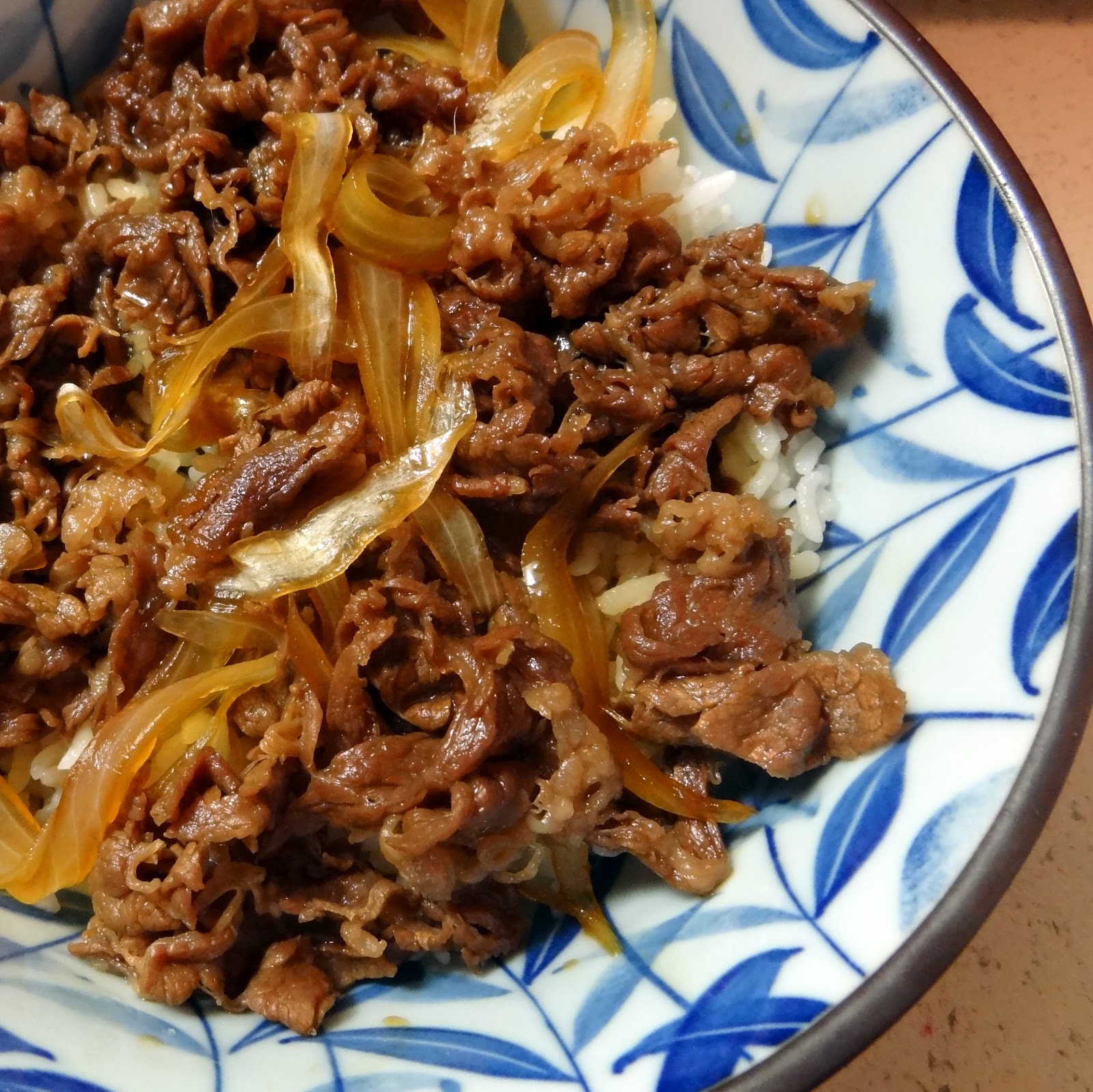
Gyudon (牛丼)

Gyudon is a relative newcomer to the donburi scene. Because of the era of Nara Buddhist rule, beef was outlawed from being consumed for over a thousand years until the Meiji Restoration. In fact, all four legged creatures were illegal to slaughter for food, partly because of Buddhist beliefs, but also to protect necessary draught animals during famine.

But with the push for more Western ideas, the Meiji Restoration lifted the ban on beef and pork consumption. Even then, beef was a bit of a luxury, due to the lack of land in Japan and the need for the cattle to help with rice cultivation. After rice cultivation was mechanized in the 1950s, cattle were no longer needed and beef consumption picked up along with the price becoming more affordable for the common man.

Still, even today, Americans consume a lot more beef than Japanese. Over in Japan, it's just more expensive, usually needs to be imported, and not as traditional as fish or even pork.

Doesn't mean that they can't cook a mean piece of cow though!

Now that you are all either asleep or bored with history lessons, let's talk a little more about gyudon. Gyudon is traditionally beef and onions cooked in a salty-sweet dashi and soy stock and poured over a bowl of rice. Additions like eggs and shirataki noodles are common, as well as a garnish of pickled ginger called beni shoga. This is Japanese fast food at its best!

Gyudon is one of the best selling donburi in Japan, and in my chikuwa teriyaki donburi recipe where I talk about the donburi in general terms, I mentioned that gyudon is what put donburi establishment Yoshinoya on the map.

Thursday, September 20, 2012

Roasted Shiitake "Bacon"

Funny story: As I was writing this blog post, I was munching on some delicious fresh shiitake mushrooms my mom and I just scored at the farmer's market. They smelled so good, I couldn't resist. I decided to google "shiitake" just to make sure I wasn't doing anything dumb like spelling it wrong. The wikipedia page confirmed I'm not as dumb as I think I am, and had some cool trivia on shiitakes that I enjoyed scrolling through as I happily snacked on these fragrant and earthy mushrooms.

Shiitake Dermatitis: "Consumption of raw or slightly cooked shiitake mushrooms can cause 'an erythematous, micro-papular, streaky, extremely pruriginous rash' that occurs all over the body including face and scalp, which appears about 48 hours after consumption and disappears after 10 days."

Seriously?  Spit-takes are not just for comedic effect.

Now I am beyond itchy, even though literal seconds after ingestion. Obviously it's just psychological, but I can't help but imagine I am going to be dying a horrible fiery and itchy death as I claw through my own skin.

I've got 48 hours to wonder if I am one of the unlucky ones, about 2 in 500. Apparently cooked shiitake have no itchy perils, so with this recipe you are all safe!

This roasted shiitake recipe is tasty, but I don't think it tastes like bacon, it tastes like crunchy delicious addictive amazingness. Which sounds a lot like bacon actually. I'll let you be the judge.